SEARCH


Micro-depaving for cooling historic centers: the simulation that transforms Catania's "urban voids" into climate resources.

Urban planners and scientists are grappling with strategies for adaptation to climate change for years now. And they tend to propose, necessarily, increasingly practical, economical, scalable, and circular solutions. Moreover, if we want to take concrete action on cities and mitigate climate change, urban heat islands, it is necessary to study strategies that can be applied with the least possible effort and without interfering with the architectural and structural features of urban centres – something particularly important in densely populated cities with a significant historical and cultural heritage “wedged” between the buildings.
Urban voids as a resource to improve the habitat of a large city center
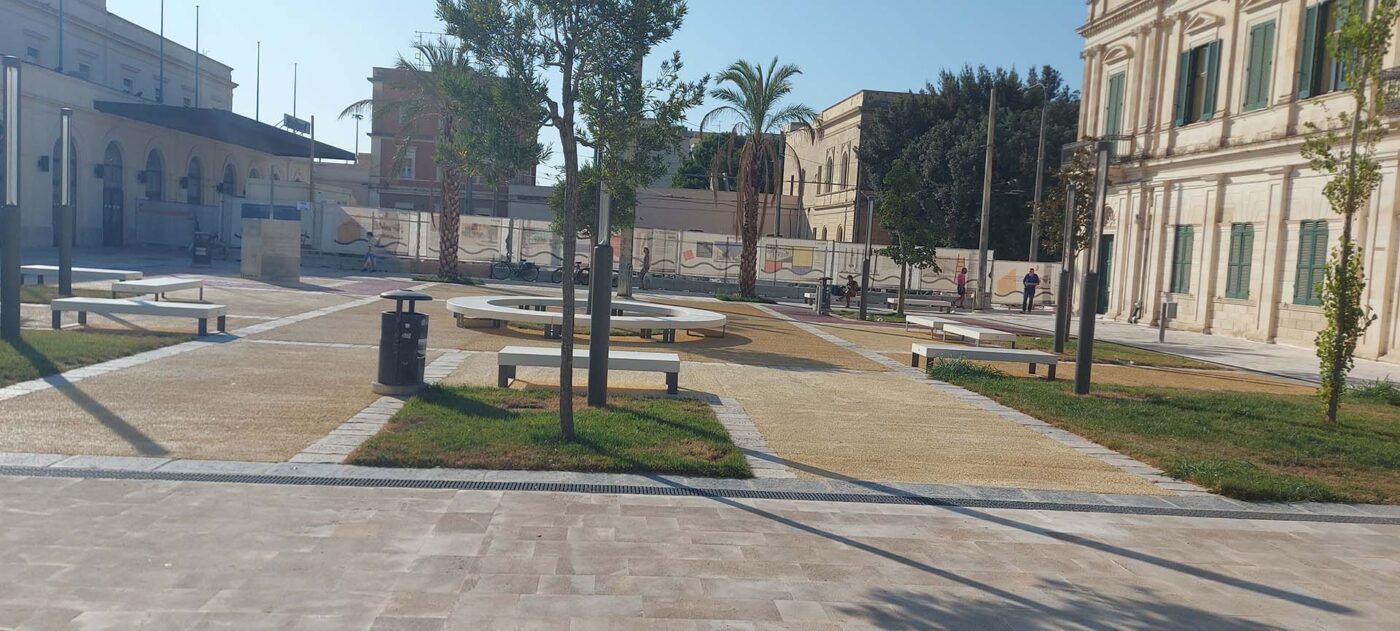
In the now distant 2010, the urban voids were the protagonists of a Spanish project that had enormous resonance. It was called “estonoesunsolar” and it was thought by Ignacio Gravalos Lacambra and Patrizia Di Monte of the studio Gravalosdimonte Arquitectos to give new value to the unused spaces of Zaragoza's historic center. The temporary interventions were born from the idea of occupy 100% of the available space in the city, following the needs and proposals of those who would then live in those spaces returned to the community.
Today, faced with a climate crisis that is advancing faster than expected (it's not true, but we are self-indulgent), and which is showing its dramatic effects especially in urban environments, urban voids are once again showing themselves as a potential resource. This time it's not about giving life to the invisible by giving spaces a social and community value, but about exploit undeveloped and unused areas of historic centers to mitigate heat waves.
In Mediterranean cities, the number of heat-related deaths has tripled. The summer of 2025 has sounded an alarm bell that no sensible urban planner or administrator can ignore. Effective and easily replicable adaptation strategies are needed, because European cities (and beyond) urgently need tools capable of mitigating heatwaves, and they must be able to do so quickly. Despite all the limitations that this entails, from local government budgets to architectural constraints.
Catania: Climate Change, Land Cover, and Cultural Heritage
Starting from this urgency, a team of Spanish researchers decided to test a “minimal” requalification protocol designed for historic centers of Mediterranean cities, characterised by compact urban fabrics with a prevalence of waterproof surfaces and significant urban planning constraints due to the historical and cultural value of the places.
The researchers used the city of for their simulations. Catania, well representative of the Mediterranean climate characterized by hot, dry summers and mild, rainy winters, with temperature variations mitigated by the influence of the sea. As stated in the study, published in the December issue of the journal Environmental and Sustainability Indicators, the historic centre of the Sicilian city is part of the "Late Baroque cities of the Val di Noto" included in the List of UNESCO World Heritage Site, and presents itself with “predominantly medium-rise buildings, extensive mineral/impermeable roofing and a limited presence of urban greenery".
Catania also has another characteristic that makes it the ideal terrain on which to test the micro-interventions proposed by Spanish researchers: recent studies have in fact shown that the soil cover is the main determinant of differences in temperature on the Earth's surface. The Landsat 8 satellite, the researchers explain, detected differences of 15–17 °C between green areas and built-up areas, both day and night.
The idea behind the study is therefore simple: to verify the potential impact of “green micro-units” that exploit the urban voids of the historic centers of Mediterranean cities to mitigate heat waves.

Transforming the Sicilian city's urban voids into "green micro-units"
Thanks to the integration with the data from the Sentinel-2 satellite, which have a resolution of 10 metres, it was possible to study the ground temperatures in greater detail and therefore identify the most suitable urban voids for simulations, defined as “waterproofed and vegetation-free interstitial spaces, with a surface area between 15 and 100 square metersAs the researchers explain, the selected areas are publicly or semi-publicly owned, easily accessible, and more than 100 meters from green or redeveloped spaces. Among these, 23 "highest priority" areas have been identified, based on thermal and feasibility criteria.
I 23 urban voids, located in the Civita and San Cristoforo neighborhoods, were fed to ENVI-met, a microclimate simulation software widely used by architects and urban planners. The "minimal" protocol for green micro-units includes pavement removal, implementation of sustainable urban drainage systems, installation of permeable pavements and planting of young specimens of hackberry (celtis australis) approximately six meters high. By now, the effectiveness of these interventions in mitigating the effects of the urban heat island is well documented and verified. The simulation results, however, exceed all expectations.
The results: -8,3°C on the ground, -2,1 degrees Celsius at human height
As stated in the research, within the 23 green micro-units the average surface temperature of the land has decreased by about 8,3 °C, with maximum peaks of -12,1 °C. The air temperature at human height, however, dropped by an average of 2,1 °C, with maximum peaks of -3,8 °C. The "physiological equivalent temperature” – a comfort parameter that combines temperature, humidity, radiation and wind – decreased by an average of 4,6 degrees. The general situation, therefore, would go from being perceived as “very hot” (over 41 degrees) to being experienced as simply “hot” (between 35 and 41 degrees, according to the parameters used to define the Physiological Equivalent Temperature).
Furthermore, the cooling effect would extend for about 20 meters to the surrounding areas, just like small urban parks. Re-waterproofing a few square meters of unused space and planting a young hackberry tree could make a difference.
Clearly at the moment these are only simulations that will need to be verified in real conditions. micro-depaving, however, is beginning to take on the characteristics of a particularly promising mitigation strategy. It can rely on scientific data obtained from very high-resolution instruments, as demonstrated by the Spanish study, is easily reproducible and has minimal impact on the city's architectural dynamics, configuring itself as a "widespread greening” particularly suitable for the historic centers of our cities.
Here are three insights that might interest you:
Nature Restoration Plan: Italian cities at a crossroads
Less asphalt, more trees: Swiss cities brave extreme heat
De-sealing and circularity: what happens if you reuse asphalt?