


 SEARCH




Launched by NASA in competition with the European and Canadian space agencies, the James Webb has a value and interest that go beyond science
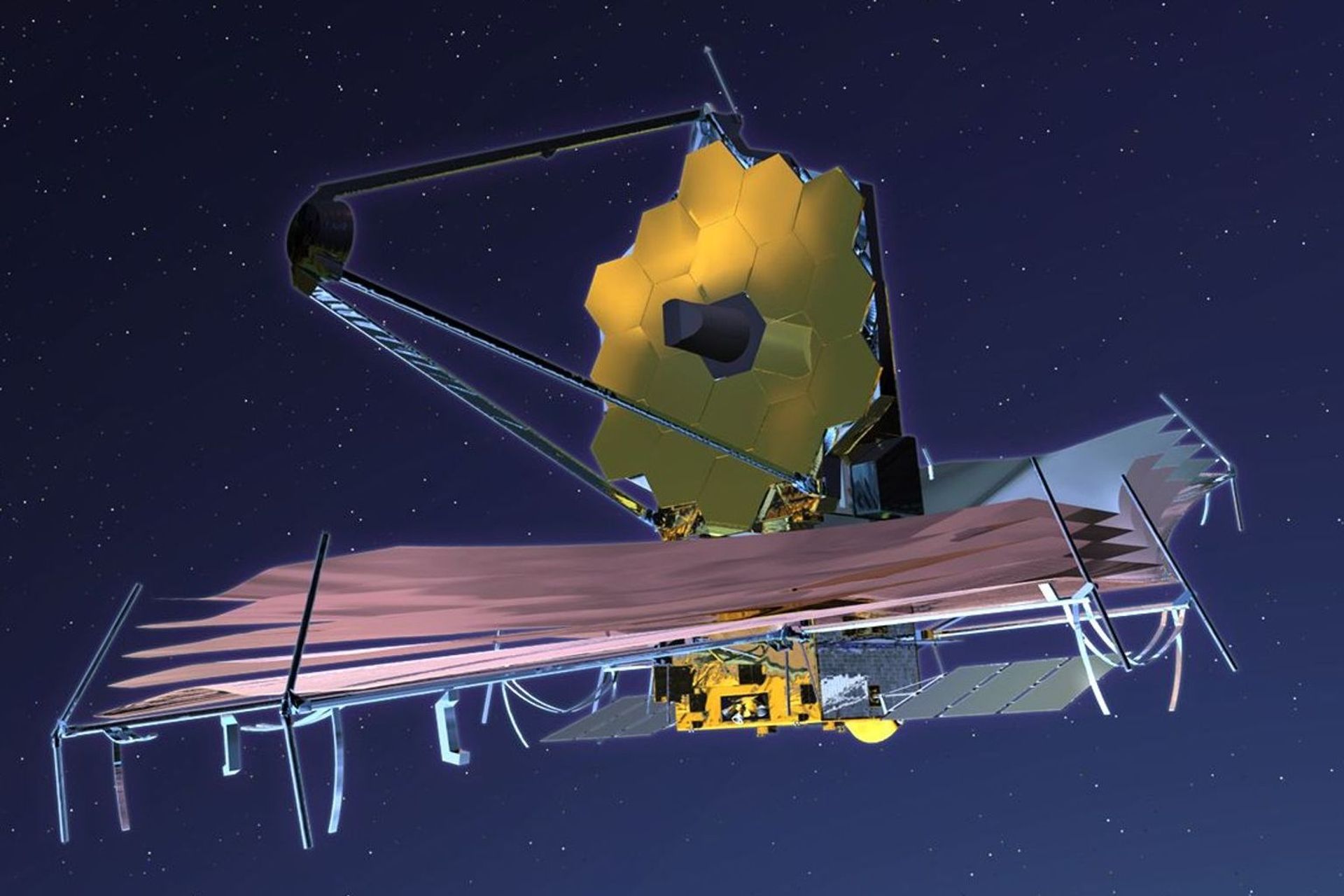
There has been a lot of talk in recent months about the James Webb, the new space telescope launched by NASA in collaboration with the European and Canadian space agencies.
In this article we try to understand the value and interest, not only scientific, of this incredible machine.
LaMDA, Google and the virtues of a… “pocket professor”
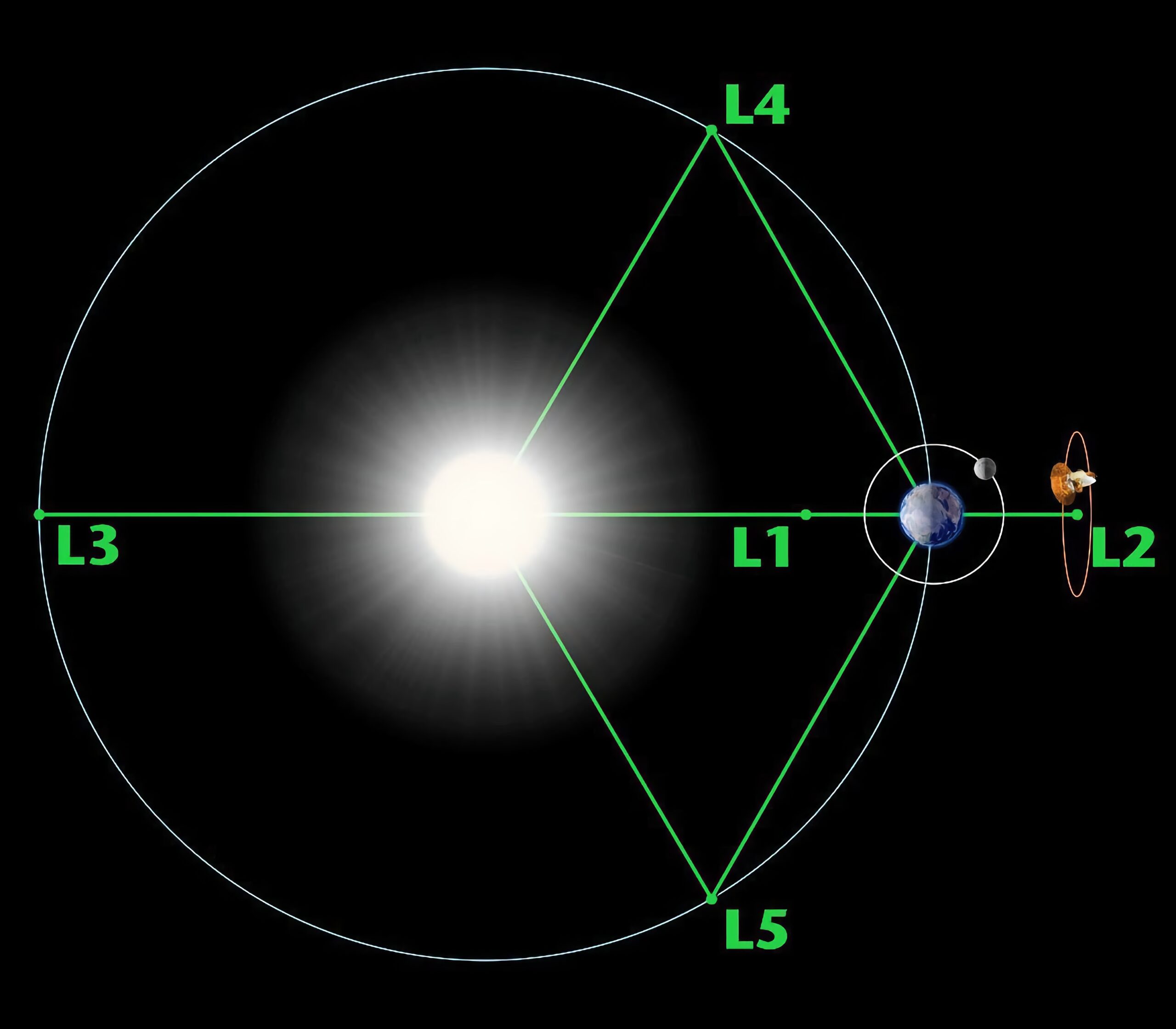
An autonomous and demanding "parking" 1.500.000 kilometers away
Let's try to imagine living on a planet much, much bigger than ours. Or on the Ringworld of ring world.
We have to park our car, but the parking lot is about 1.500.000 kilometers away.
So we have to calculate a route and a starting speed such that, by pure inertia and with perfect precision, our car arrives at the assigned parking space.
In practice, we can only give a good initial push and then the car will have to do everything by itself, except for some minor corrections.
And if it doesn't park well, we won't be able to go and put it in the right place. Or maybe yes, but not for ten or fifteen years.
Absurd and crazy isn't it? Yet that's what we did (“we have” in the sense of the human species, of course) with the James Webb Space Telescope, in one of the most complicated, advanced, and risky (for the telescope) engineering feat in history.
Those three rescue goals of the Internet from… itself
Wandering around the cosmos with the difficulties narrated in the… film “The right to count”
Obviously the example above is forced: when traveling in outer space, one must not take into account the existence or otherwise of highways, the friction of the ground or the air, any obstacles (with some exceptions).
However, it remains useful for understanding the calculation difficulties faced - and overcome - for this mission at the extreme limits of our current technological capabilities. But let's go in order.
At the time of the first space travel, when the use of computers was still closed to a few large military or university laboratories, NASA itself (National Auronatics and Space Administration, the body responsible for civil aeronautical and aerospace activities in the USA) used groups of young women to carry out the complex calculations necessary to define the orbital trajectories (for those interested in this truly fascinating story, I recommend seeing the film "The right to count").
Later the "human calculators" were joined by an IBM 7090, a second-generation, transistor-operated computer that occupied a large room and was capable of 230.000 additions or subtractions per second (40.000 multiplications or divisions).
Thanks to her calculating skills - truly exceptional at the time - and to the genius of some of these girls, John Glenn's first orbital mission was successful.
The algorithm of social stupidity is not the result of social networks
Why is it complicated? In play difficult equations and an infinite number of factors
But why is it so complicated? After all, a good push is enough and you are in space, right? No.
The equations describing these trajectories are extremely complex: numerous factors must be taken into account, both in the early stages of atmospheric flight, in low orbit and in deep space.
New mathematical methods (sometimes the reinvention of old methods) have been created to solve these problems, and still today it is no joke: both for the speeds and energies involved, and for the engineering complexity of engines and vehicles.
Have you ever wondered why it took decades and a crazy visionary like Elon Musk to build rockets capable of landing like in the Buck Rogers comics, like the F and the future Starship?
Today computers are much more powerful and the mathematics of spatial trajectories are well known.
Just to do the math, the IBM 7090 had an average computational capacity of about 100.000 floating point operations per second (100 kflops), cost $3 million at the time, equivalent to about $20 million today, and occupied a pretty large room. great at NASA.
An M1 chip in a current Apple MacBook Air, a portable computer costing about $1.000 and weighing 1,3 kilograms, has a GPU (graphics computing unit) capable of developing 5.200.000.000.000 (5.200 billion) floating point operations per second (5.2 Teraflops). That's 52 million times faster.
That strange perception of digital in the absence of know-how
Six months for the delicate set-up works and thirty days of slowdown
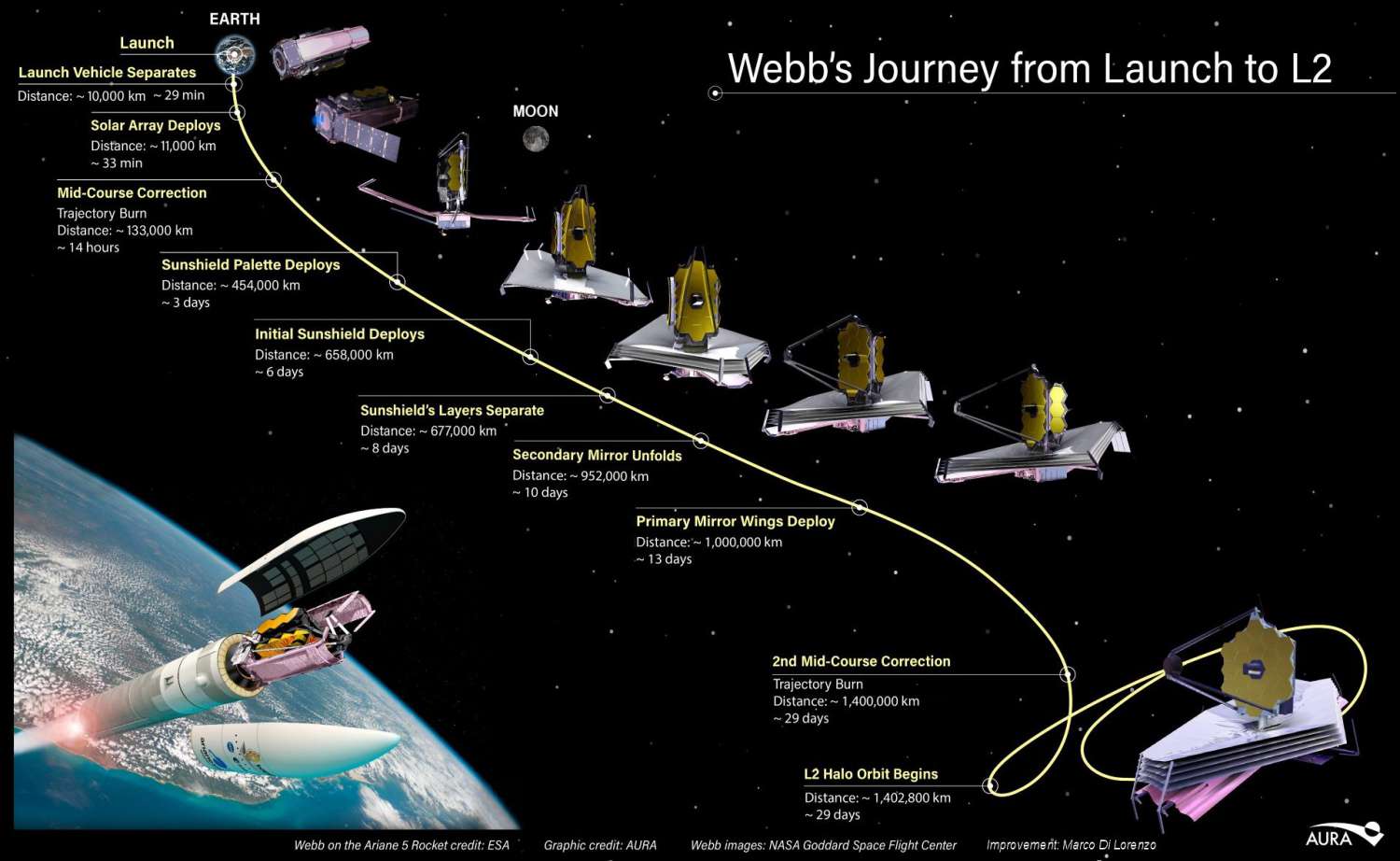
So our dear James Webb was launched with an Ariane 5 rocket from the Kourou spaceport in French Guiana, being the mission in collaboration between NASA, ESA (European Space Agency) and CSA (Canadian Space Agency), he arrived in low orbit around to the Earth in a few minutes, then with another big push it set off towards its "parking", in the direction of which it traveled for thirty days gradually slowing down, so as to place itself in its own orbit at the right speed.
It then completed the fine-tuning phase, a series of very delicate operations that lasted about six months.
The Space Race? Fair compensation for baby boomers
From five to ten years of operation to twenty thanks to a very precise machine
The operation was so precise that it consumed much less fuel than expected for the necessary course corrections, thus the duration of the useful life of the telescope increased from a minimum of five to a maximum of ten years to as many as twenty years of operation.
Why put a telescope in space?
It should be noted that not all telescopes operate in the frequencies of light visible to us. Indeed, in many cases other frequencies are much more useful for doing science.
Basically, a telescope in space is unaffected by the deformations and disturbances caused by our atmosphere.
It doesn't even have to deal with the presence of satellites and artificial objects orbiting our planet.
So launching a telescope into space allows us much more precise observations, at least in some specific frequencies.
Those "dark realities" full of (new) mysteries about the cosmos
A look extended to 13 billion light years of the 13,8 of life in our universe
James Webb was NASA's second administrator at the time of the Apollo missions.
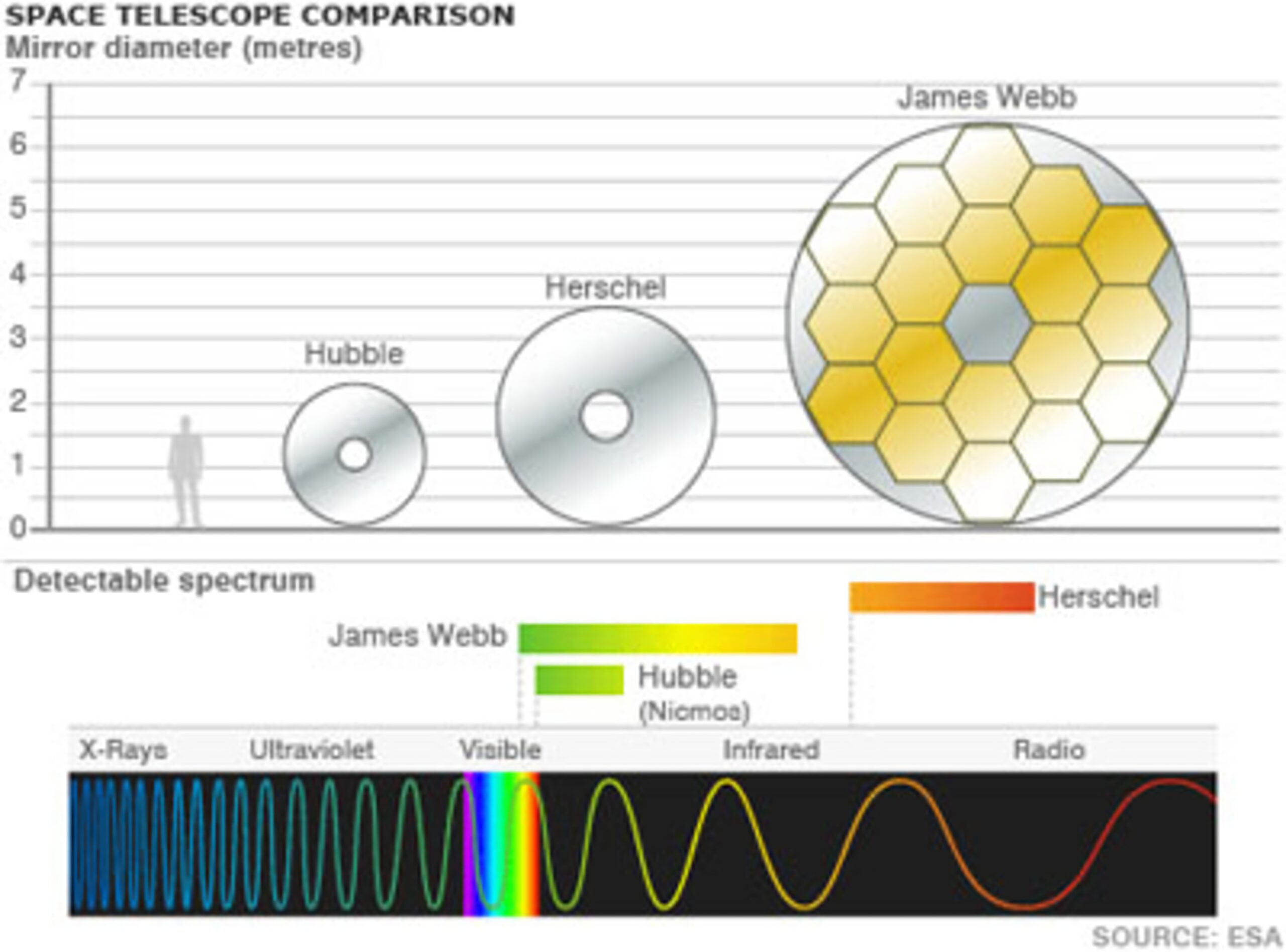
The telescope dedicated to him operates in the field of visible light from 0,6 microns (visible red light) to 23 microns (mid infrared).
Thus it is different from its predecessor, still functioning after 22 years of honorable service, the Hubble Space Telescope, which observes between 0,1 micron (ultraviolet) to 1 micron (near infrared).
The JWST is therefore designed to see, with a resolution unthinkable until now, the most distant objects in the visible universe, over 13 billion light-years away.
That is the beginning of the Universe as we know it, since it has existed for approximately 13.800.000.000 years.
Since light has finite speed, if we see a galaxy 13 billion light years away, we see a galaxy 13 billion years old! Creepy, right?
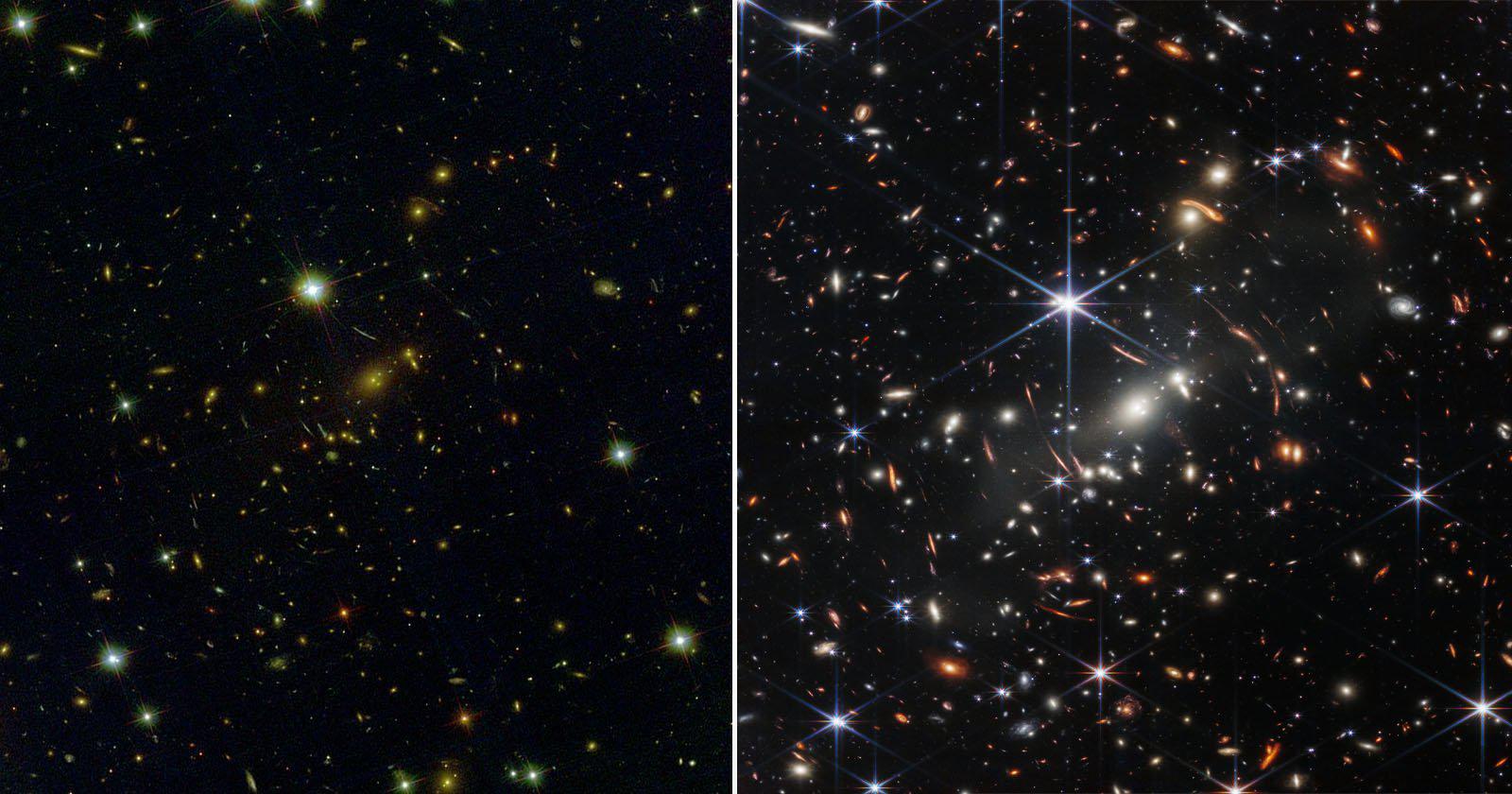
An evocative image shows the same portion of the sky seen by the Hubble Space Telescope (100 days between exposure and processing), on the left, and the same work done by the James Webb Space Telescope (one day), on the right.
The portion of sky observed in the double image is the size of a grain of sand held in the hand with an outstretched arm.
And what you see are almost all galaxies. Those that appear "stretched" are deformed by the so-called "gravitational lens" caused by the large masses present between us and the origin of the photons.
Just as Albert Einstein predicted over a century ago.
“The Montecristo Project – The First Colony”? A book-world
Since "far" 1996 to today, the JWST has cost 10 billion dollars
The project was born in 1996 and was initially scheduled for launch in 2007, then in 2016, finally in 2022.
The initial budget of 500 million dollars has grown to 10 billion dollars over the years: money well spent, before anyone starts to get scandalized.
These are ridiculous figures, compared for example to what we spend every day on weapons globally.
Delays and higher costs were due to problems with the cooling system, heat shield, fuel management valves, excess vibration during launch.
It was an extremely demanding project also for the entities involved, both economically and in terms of engineering.
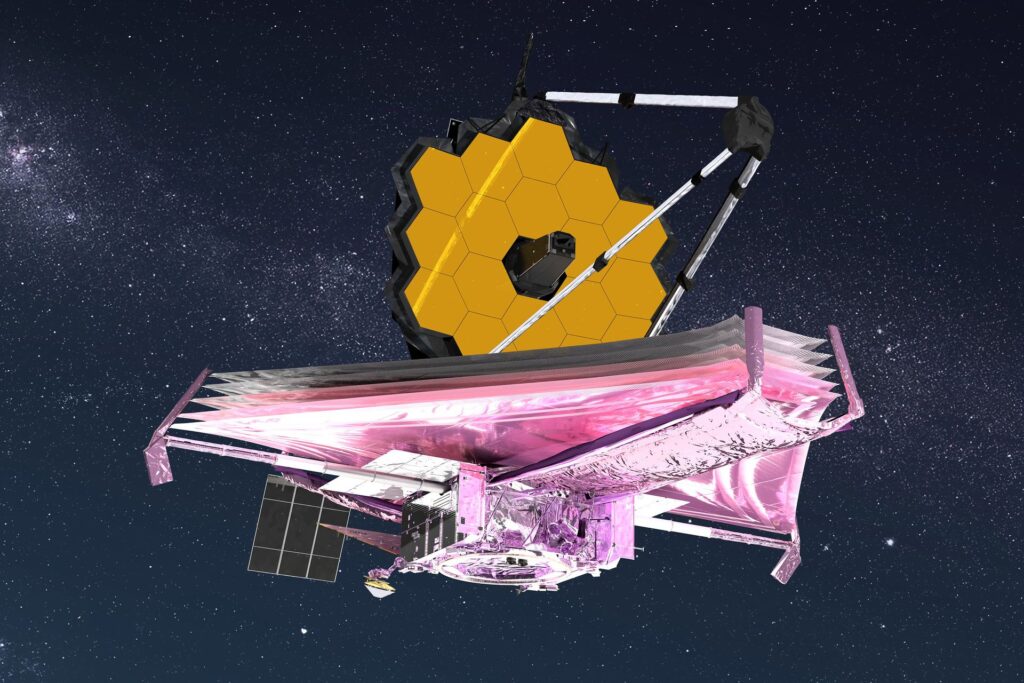
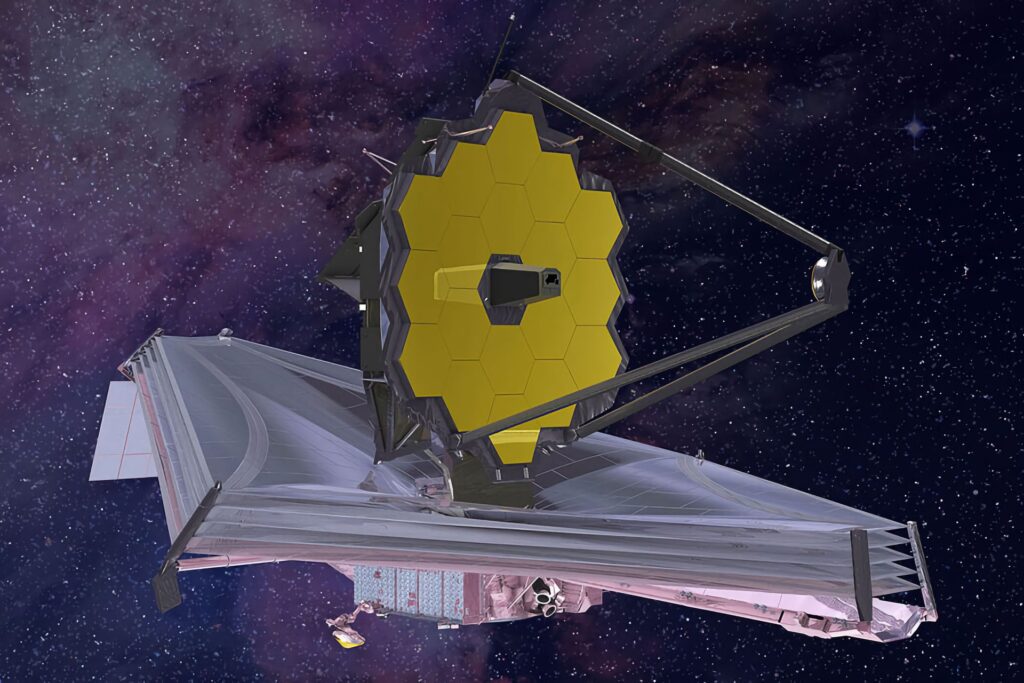
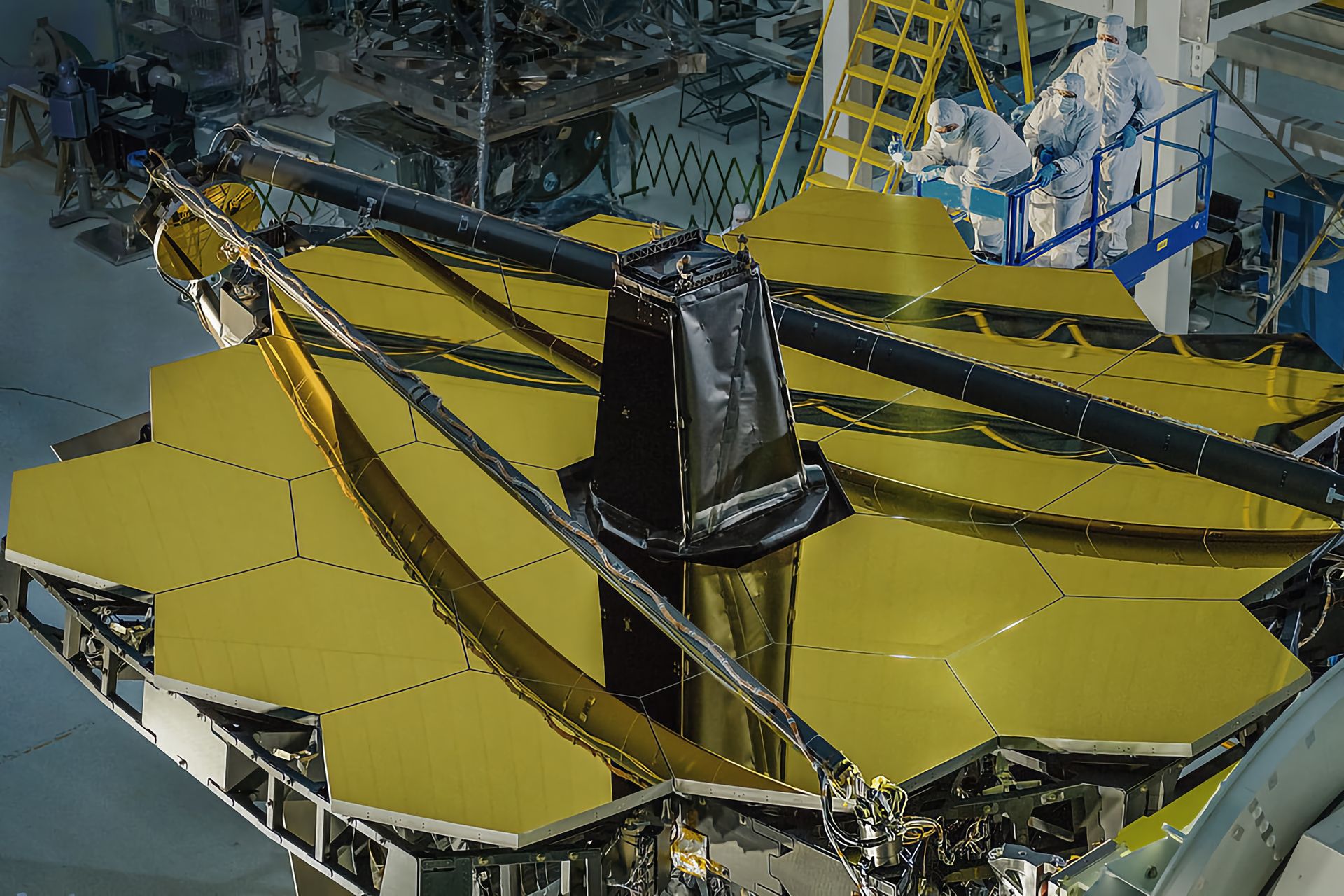
The James Webb is truly a large telescope, the largest ever sent into space: no longer a single, monolithic mirror, but a good 18 hexagons arranged in a honeycomb to reach a diameter of about six and a half meters.
It was an Italian idea from the 30s to segment the mirrors of large telescopes, now used in most cases, also for terrestrial telescopes.
Now, the JWST is a modern and very complex instrument, perhaps the most complex built so far.
At the bottom, it has a sunshield (we'll see why later), solar arrays, trim motors, propellant tanks, radiators, communications antenna
The black scientist and that "Nazi" voice in space
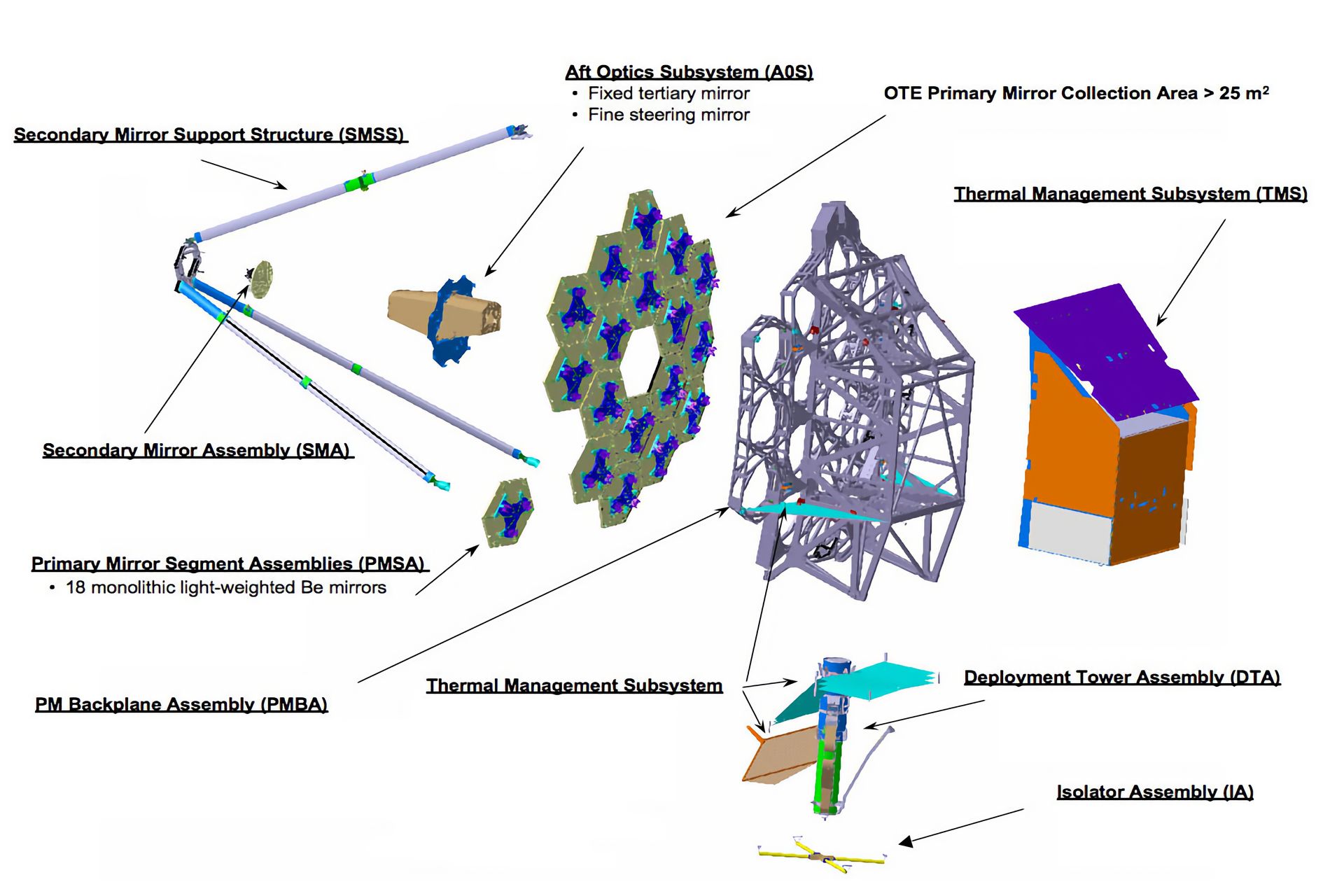
18 beryllium segments mounted on a carbon fiber and plastic structure
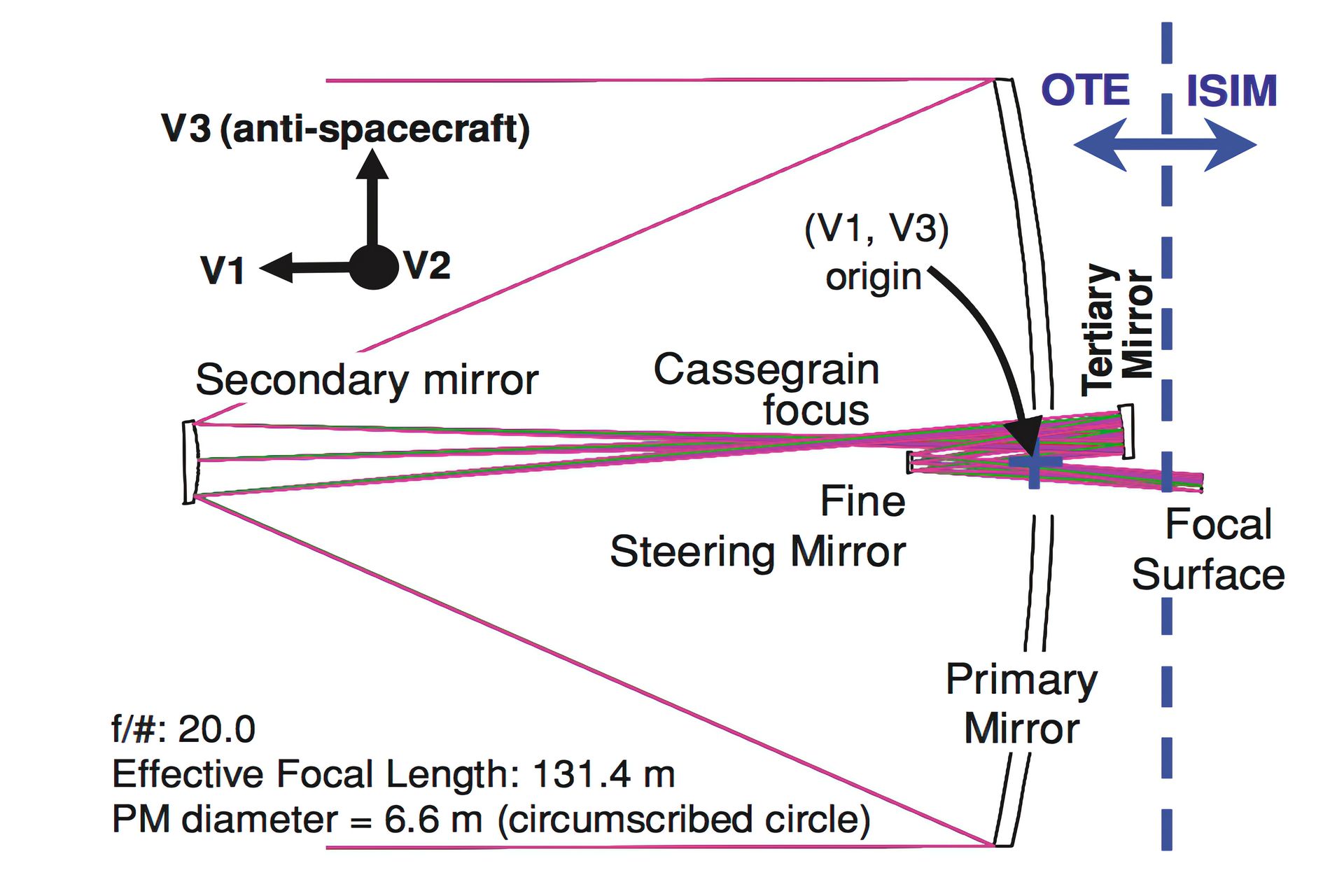
In the upper part we find the optical part with the primary mirror (parabolic), the secondary mirror (hyperbolic) and the image collection in the center of the primary, made up of 18 beryllium segments mounted on a carbon fiber and plastic structure, all on an extendable tube that connects it, but also keeps it separate, from the rest of the structure.
The use of beryllium is quite unique, and the large mirror can be deformed with extreme precision thanks to dozens of "actuators" behind it. The optical part thus manages to obtain a good 131 meters of "focal length".
Two other mirrors, a fixed tertiary and a mobile quaternary, are used to compensate for micro-movements during observation.
The primary shield is gilded to exclude as much as possible radiation of wavelengths of no interest, and the gilding in turn is protected by a very thin transparent layer of silicon.
Sky Cruise is the nuclear giant of the 5.000-passenger skies
A precision such as to be only "a few atoms" away from the ideal optical vision
The optical precision is such as to be "a few atoms" away from the ideal shape (and on this many engineers will jump on their seats).
Just to give you an idea, a non-exhaustive list of scientific instruments includes a bouquet of truly exceptional instruments:
- NIRCam (Near-Infrared Camera) for images from 0,6 to 5 microns;
- NIRSperc (Near-Infrared Spectograph), same band, with 200.000 (two hundred thousand) micro-shutters each capable of focusing on an object observed by the telescope (for example, a star); of European manufacture (Zeiss – Airbus – Astrium) it was not easy to develop;
- FGS-NIRISS (Fine Guidance System / Near-Infrared Imager and Slitless Spectrograph) – Camera for fine adjustment of telescope pointing and spectroscopy from 0,8 to 5 microns;
- MIRI (Mid-Infrared Instrument) – 5 to 27 micron chamber and squeezer, equipped with coronagraphs to locate and observe exoplanets
The first "flag" on the Moon? It was white and made-in-Switzerland
A collaborative medium, but the James Webb is by no means the heir to the Edwin Hubble
So the James Webb is not the successor of the Edwin Hubble telescope, but a very different object with different objectives.
The trend in research today is to put together many specialized tools and then, thanks to the great power of collecting, sharing and processing current data, combine the results into images of great interest and fascination.
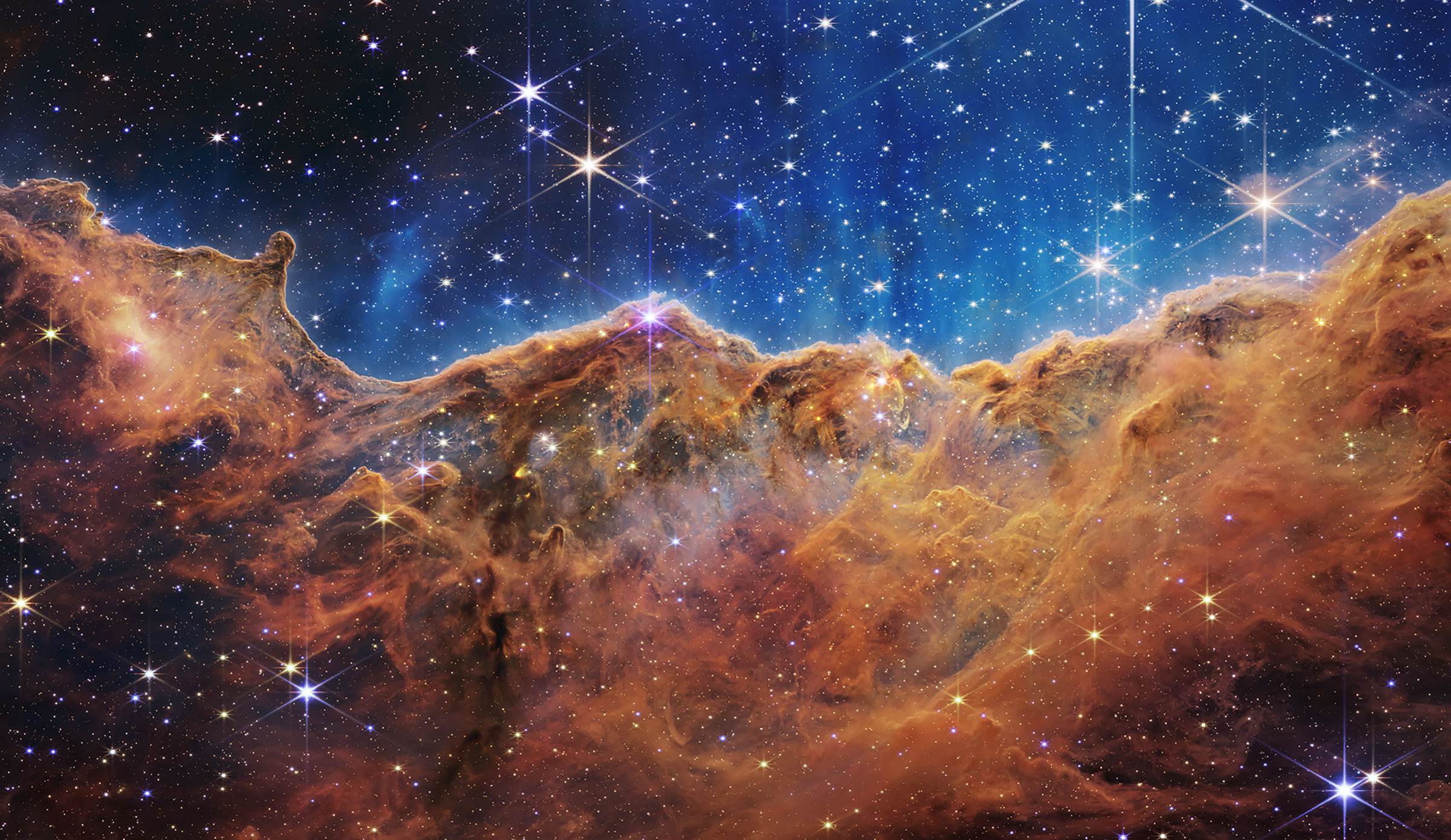
An important premise is worth making. All telescope images, including those of Hubble, are artificially modified in "false colors" to make it more evident the presence or absence of specific elements.
So we wouldn't see those beautiful colors if we were physically in space at the right distance. But they are not “just fake” colors, added to beautify. They have a precise scientific meaning, and this is also very nice.
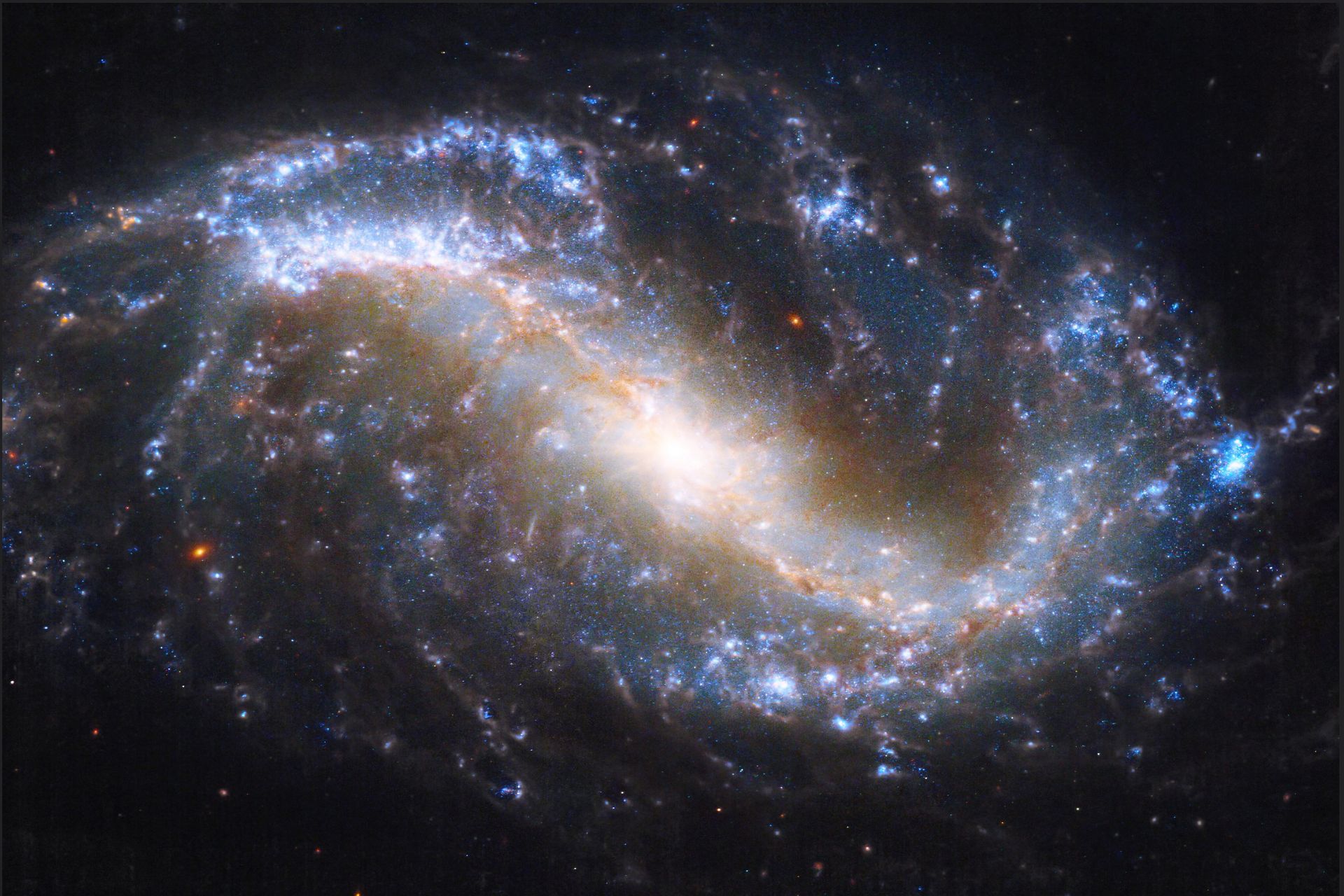
This image is the result of a combination of data from the JWST (in both near and mid-infrared) and the Edwin Hubble Telescope (in visible light).
This is NGC 7496, an elegant barred spiral galaxy 24 million light-years away in the constellation Crane.
Of course, the colors in the James Webb data aren't real, since the telescope captures light that our eye doesn't associate with any color.
Because red, green, and blue are associated with data taken from the Edwin Hubble, cyan was used for the near-infrared and orange for the mid-infrared for the new space telescope image.
These images are not only beautiful, but help us to have a more complete view of the objects we are observing.
While the Hubble, capturing visible light, shows better the great central bar of the galaxy and its long spiral arms, the Webb in the infrared brings out above all the clouds of dust inside the galaxy, almost completely obscure for the previous telescope (and thanked the Facebook group “Who's afraid of the dark?” for the image and for the description).
Amazon in orbit to boost our internet access
Very cold, very still: no moving elements and MIRI at minus 267 degrees
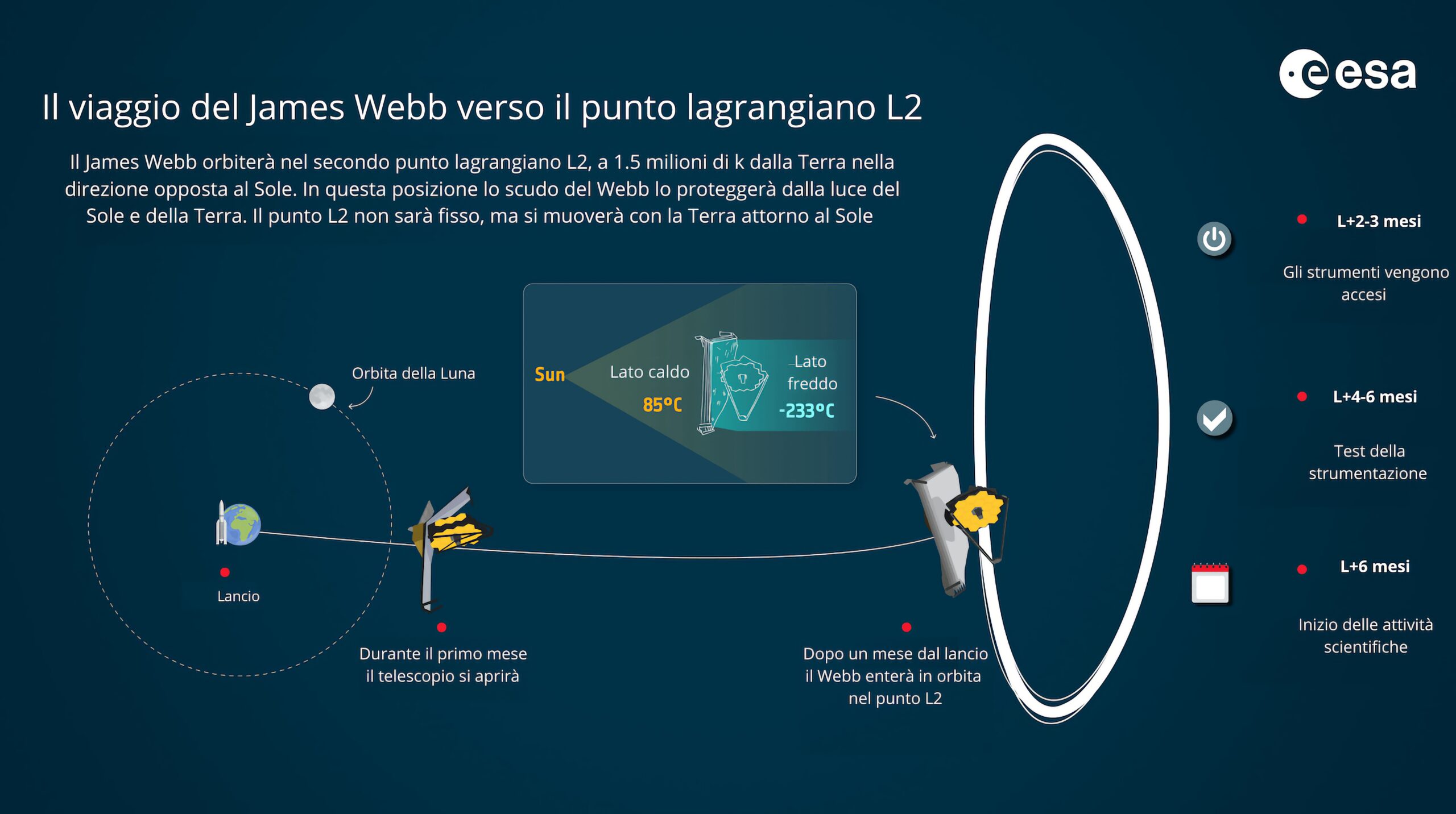
Another interesting and intriguing technological feature. For the James Webb telescope to work well, it must be very cold, roughly 230 degrees below zero, while the MIRI instrument is further cooled down to minus 267 (6 Kelvin) with an extraordinary "refrigerator" with no moving parts, which uses a system of acoustics capable of cooling the helium (a system that will probably have important technological effects on Earth as well).
This is why the solar shield formed by 5 layers, and this is why we placed it in an orbit so far from the Earth, where it is currently impossible to go and repair it.
Furthermore, it must remain very still: no motor with moving parts is present in the structure, no electronic circuits or cameras that are not absolutely essential, apart from the pointing systems in space.
The slightest vibration could disturb the results and shorten the life of the telescope.
The lunar year kicked off Lamborghini's NFT project
Thus the JWSP solar shield reduces its own temperature a million times
Here is another technology brought to an extraordinary level of efficiency for this mission: a bit like the solutions created for Formula 1, which sooner or later also arrive on our cars.
The infrared photons (heat) coming from the Sun bounce between the different layers and are laterally dissipated, bringing the 1.300 Watts per square meter of thermal incidence on the illuminated part to 0,001 Watts per square meter on the telescope side: a thermos that reduces the temperature a million times!
Just imagine this level of efficiency carried over into our refrigerators.
Twenty Swiss francs in silver as a tribute to solar energy
It is a transformer the size of a tennis court folded in just 4,5 meters
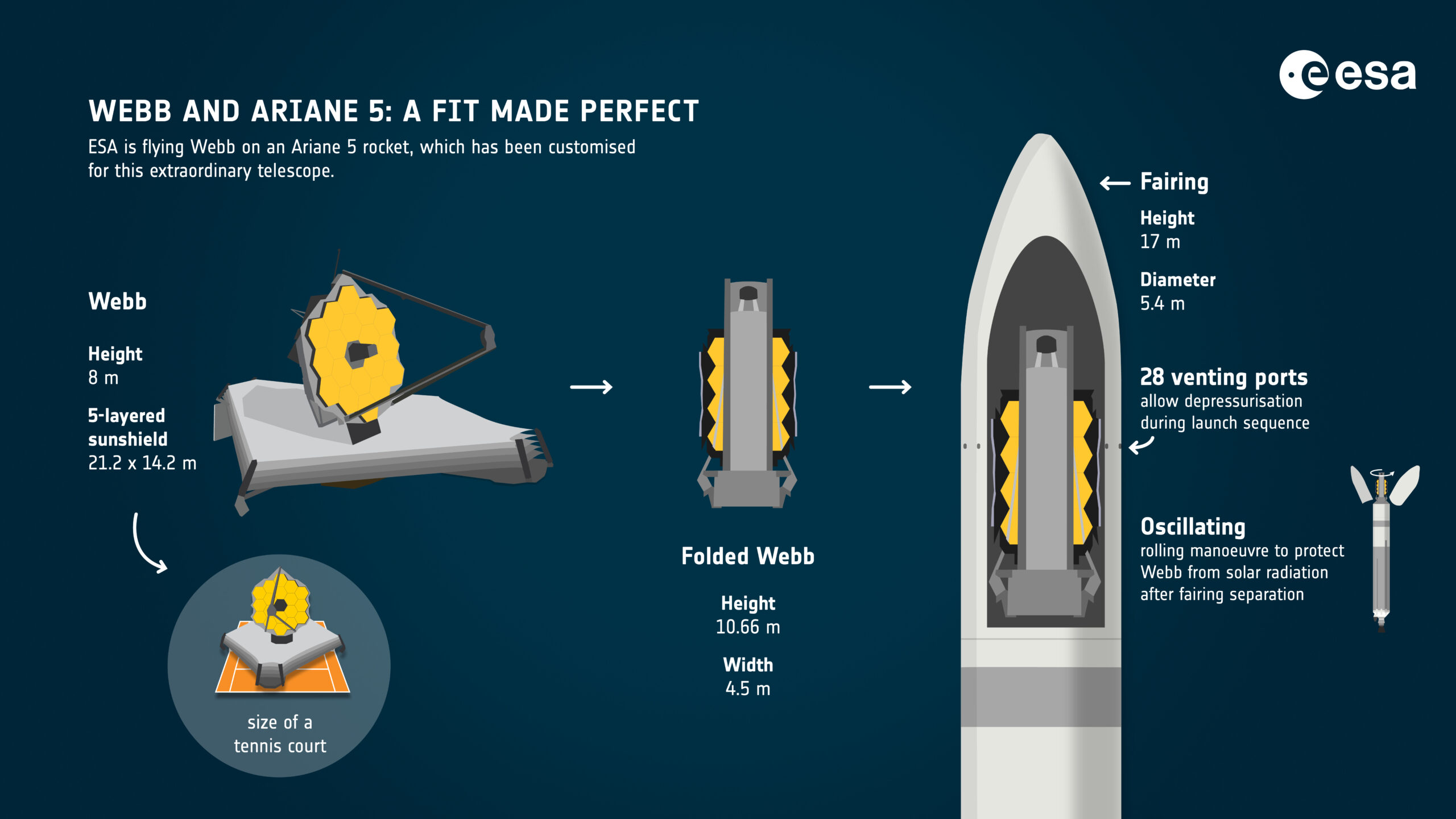
The James Webb Space Telescope is a transformer.
Already twenty years ago, when the project reached its maturity, it was planned to use one of the most efficient, precise and reliable launchers: ESA's Ariane 5.
The design of the telescope had to take this into account so that it could be contained in the rocket's nose with extreme precision.
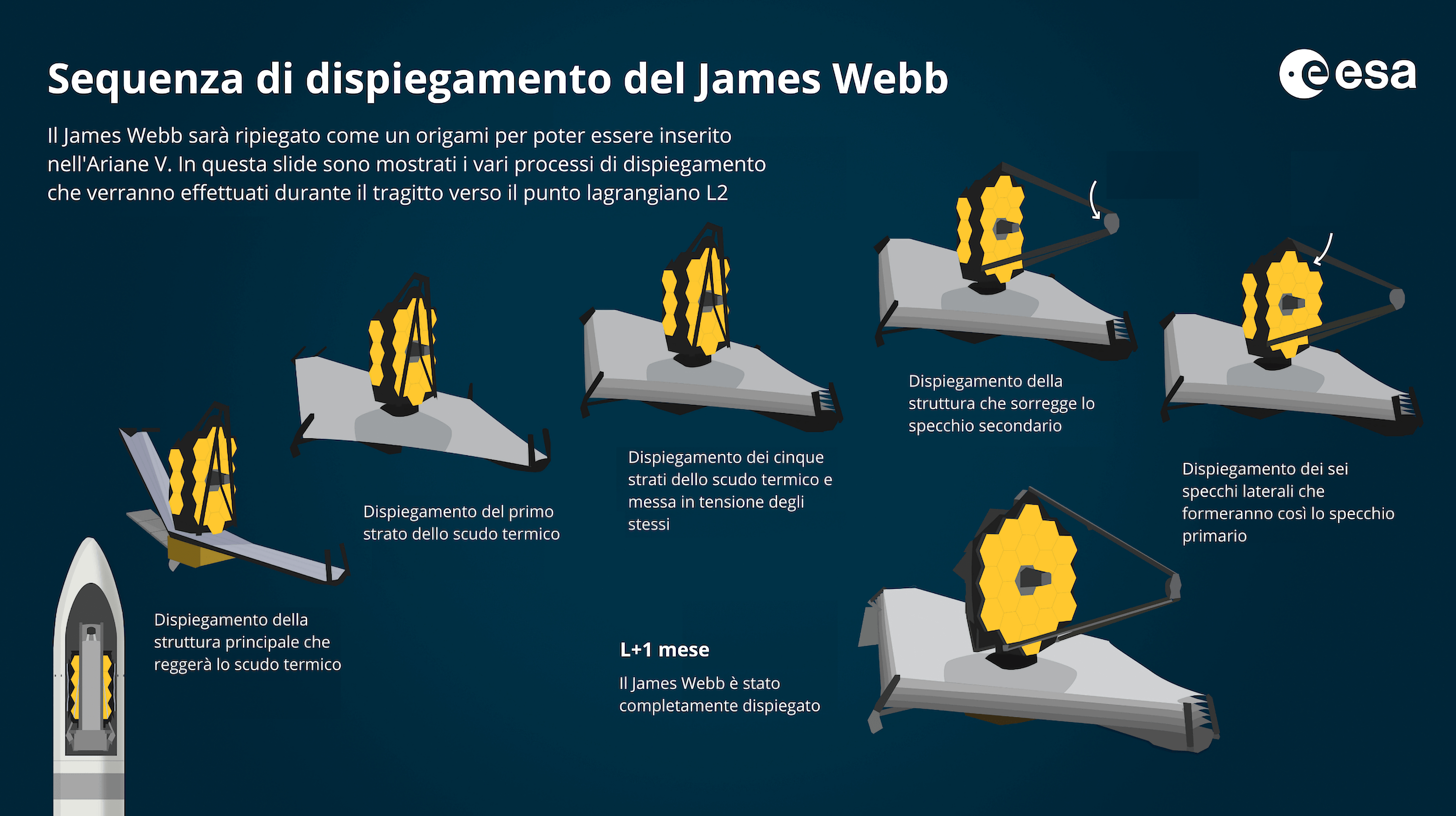
Then six hexagonal parts of the mirror were designed to fold, and the heat shield layers were in turn folded like origami, so as to reduce the size of an object as large as a tennis court (21 meters high , 14 wide, 8 high) to a load 10,6 meters high and only 4 and a half meters wide.
Ferrari's energy will come from the sun, thanks to Enel X
From Europe to Guyana by sea in a "clean room" of 65 tons and 67 meters
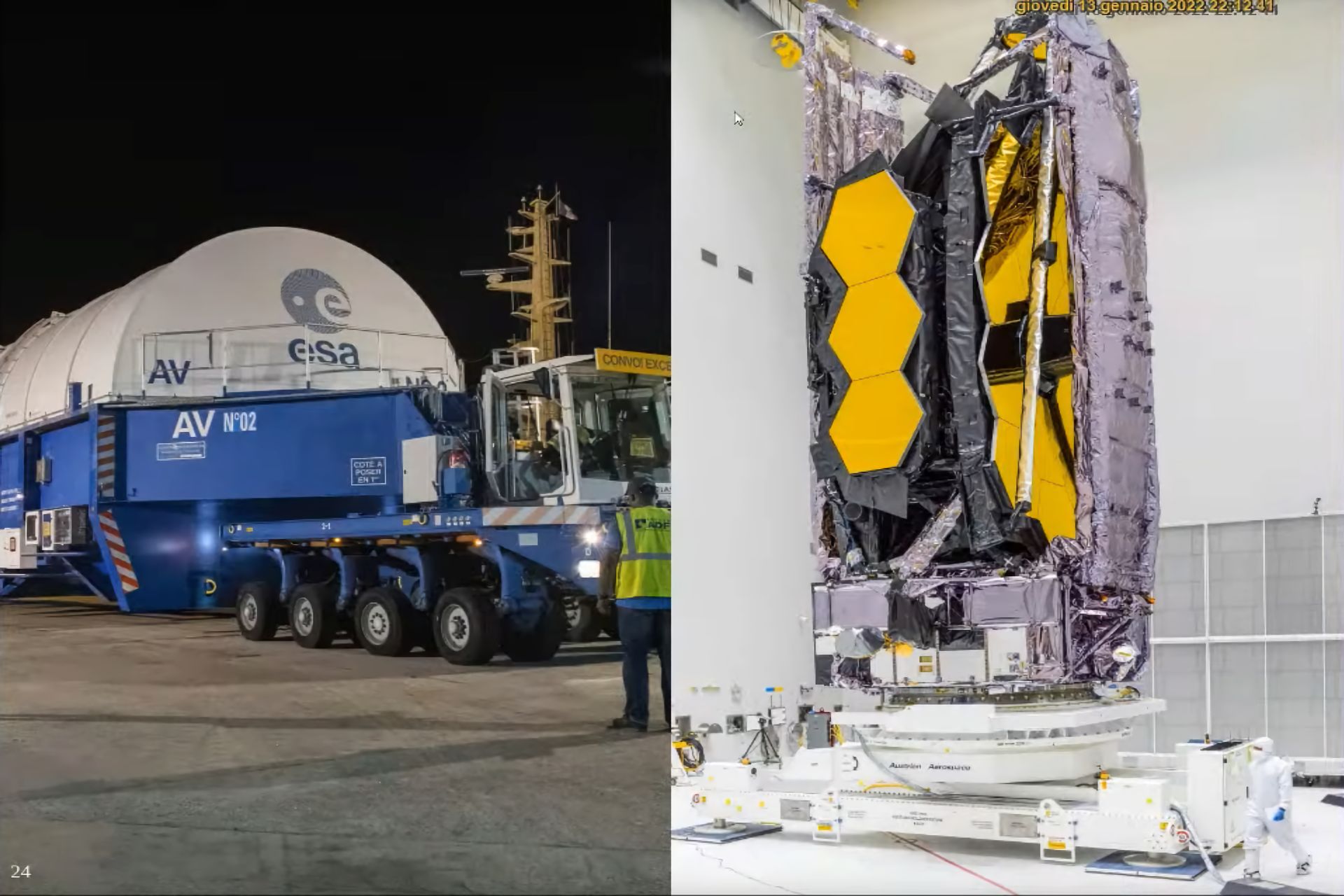
Then it was transported by land and sea to the ESA Kuru launch base in French Guiana, in a "clean room" container weighing no less than 65 tons and 67 meters long, kept under a continuous flow of liquid nitrogen to maintain ideal conditions and equipped with a vibration mitigation system.
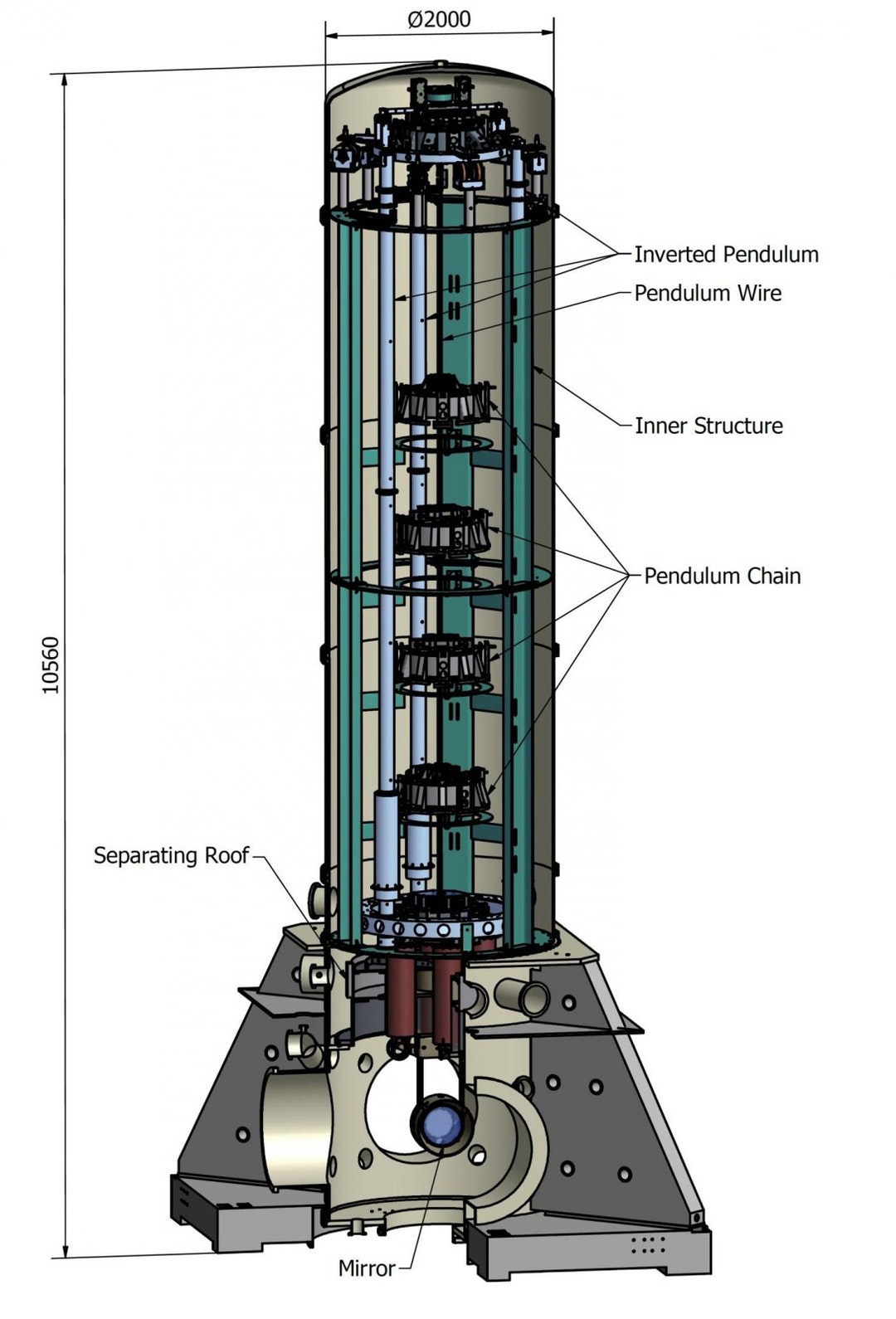
Will they have, at least in part, used the systems of "super-attenuators" developed for gravitational-wave observatories such as the Italian Virgo interferometer?
Another engineering virtuosity of no small importance, if we take into account the fact that the JWST would have had to face a long journey by land and sea, and unfold during the journey towards its target without the possibility of correcting any defects or design errors.
And resist during the launch to vibrations that can reach a level of 120 decibels without damage. Nor get too hot (so during the launch the rocket rolled so as to keep it in the shade).
Then, once it arrived at its destination, the telescope slowly unfolded according to the pattern that you can admire in another highly explanatory image. And doing it yourself!
Podcast, forty visionary years of Elon Musk from the Web to Mars
Two positive effects: thermal insulation with Kapton and new optoelectronic techniques
In spite of the people who are not yet convinced (and there are far too many), every mission in the name of space knowledge has important repercussions not only scientific, but also technological and practical in everyday life.
Here we mention a couple of techniques that we could soon see becoming commonly used on planet Earth as well:
Thermal insulation with Kapton sheets
Kapton is a polyimide film (a particular polymer formed by the so-called imide monomers) developed by DuPont. It is able to remain stable over a wide temperature range from -269°C to +400°C.
Mirror construction technology
The technologies developed to reach the degrees of precision necessary for the James Webb Space Telescope already have important effects on industrial processes and optoelectronic techniques (optoelectronics is a branch of electronics that studies electronic devices that interact with light and their applications).
These are just two examples, and in any case the images that have been shared on the Net in recent weeks have already established that the JWST will have disruptive effects above all on our knowledge of the universe, of life, of everything…
Yes in Bologna to the strategic forum for the aerospace supply chain

Sources:
Austronaticacast – Year 15, episode 5
Austronaticacast – Year 15, episode 13 (up to 58'53”)
Astronautical Forum – James Webb Space Telescope (JWST) Mission Log
https://www.media.inaf.it/2022/01/05/jwst-webb-sunshield/
https://www.esa.int/Science_Exploration/Space_Science/Webb_factsheet
https://www.astrospace.it/2021/07/29/la-guida-completa-al-james-webb-space-telescope/
https://youtu.be/n9MxqFfBTzQ (launch animation)
A true balance two decades after the discovery of the Higgs boson
The James Webb Space Telescope mounted


