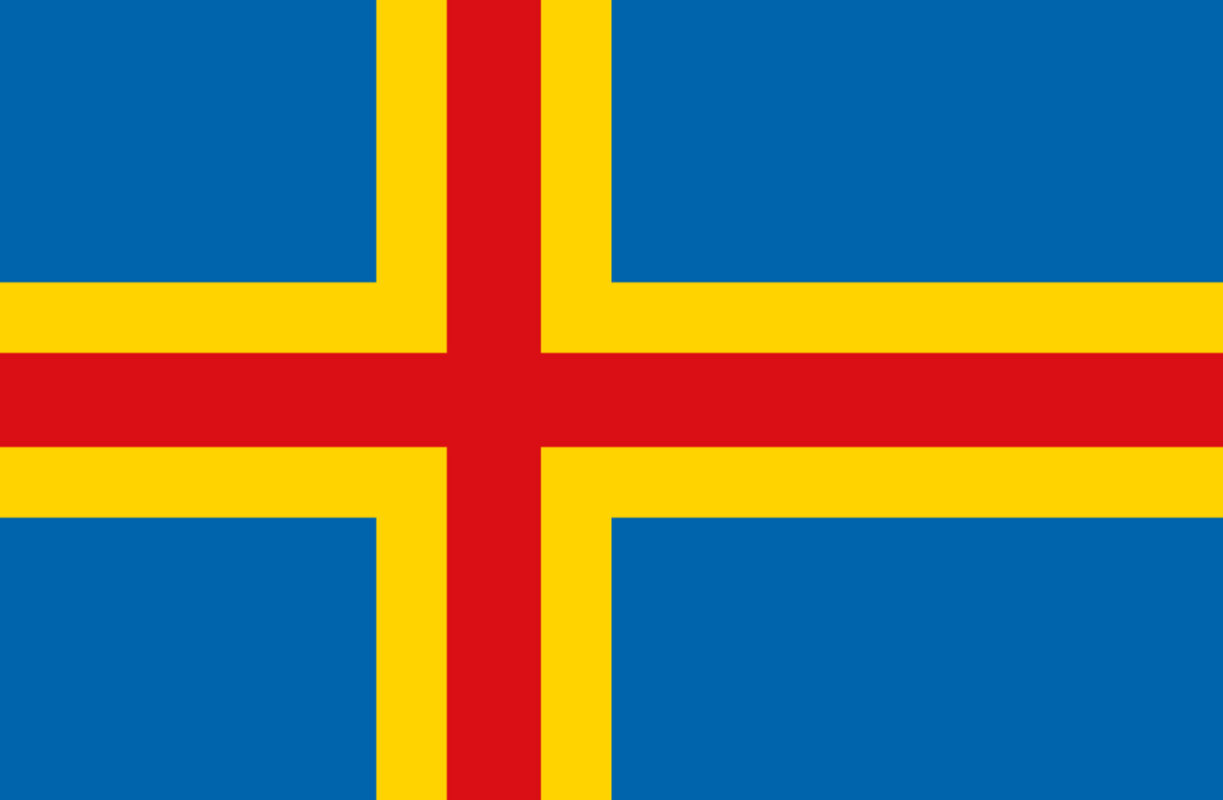
Insights into Åland
1. Country Name
- Official Country Name: Åland Islands
- Short form and long form: Åland or Åland Islands, officially designated as the Autonomous Territory of the Åland Islands.
2. Geography
- Geographical position: The Åland Islands are located in the Baltic Sea, exactly between Sweden and Finland. Although they are an autonomous Finnish territory, they are culturally and linguistically closely linked to Sweden. Åland consists of an archipelago of about 6.500 islands, of which only 65 are inhabited, which occupy a strategic position along the main Baltic sea routes.
- Area The total area of Åland is approximately 1.580 km².
- Description of the landscape: The territory of Åland is characterized by flat landscapes and a rugged coastline with low cliffs, bays and inlets, where the islands are mostly rocky and surrounded by pine and birch forests. The climate is temperate and maritime, with cold but mild winters for the latitude and cool summers, influenced by the presence of the Baltic Sea. Åland is ideal for nature-related activities such as sailing, fishing and walking in the forest.
3. Population
- Number of inhabitants: Åland is home to a population of approximately 30.000.
- Population growth rate: The population growth rate is moderate and stable, with a minimal increase, influenced by a demographic balance between births, deaths and limited immigration.
- Major cities and population distribution: The capital, Mariehamn, is home to about a third of the population, with around 11.000 inhabitants. The remaining inhabited areas are spread across small villages and rural settlements scattered across the main islands, such as Eckerö and Lemland.
4. Capital and main cities
- Name of the capital: Mariehamn.
- Information on the main cities: Mariehamn is the administrative, economic and cultural centre of Åland. Founded in 1861 during Russian rule, the town has distinctive architecture and is home to the main port, the heart of trade and tourism in the archipelago. The other towns, or rather main villages such as Eckerö, Lemland and Saltvik, are smaller centres, but each has its own historical and cultural significance in the archipelago.
5. economy
Nominal GDP and GDP per capita
Åland has an estimated nominal GDP of around USD 1 billion. This is high for its small size and population, demonstrating the economic capacity of the territory. The GDP per capita is around USD 33.000, comparable to other developed territories in Europe. This GDP is mainly achieved through sectors such as services and maritime transport, which are the backbone of the economy of Åland. In fact, the island not only enjoys a strategic position for trade routes in the Baltic Sea, but also uses this proximity to neighboring trading powers, such as Finland and Sweden, for its own economic development. In addition, fiscal autonomy helps make the archipelago attractive for investment.
Main economic sectors (agriculture, industry, services)
The most developed sector in Åland is the service sector, with particular emphasis on trade and tourism, followed by the maritime sector. Maritime transport is a key activity and includes companies specialising in the transport of goods and passengers. Tourism also plays a significant role, with visitors attracted by the unique landscape and outdoor activities. In agriculture, the island produces vegetables, fruit, potatoes and is engaged in fishing, which is a crucial resource for the local economy. Finally, industry is relatively limited, but includes processing of agricultural and fish products and a small manufacturing industry related to shipping.
GDP growth rate and inflation
Åland's GDP is growing at a steady rate of about 1-2% per year. This is partly due to the fact that the region has a stable and diversified economy, supported by Finnish and Eurozone economic policies. Inflation is kept at around 1-2% thanks to the monetary policy of the European Central Bank. This relatively low inflation rate benefits the purchasing power of the inhabitants and provides stability to local companies.
Unemployment rate and trade balance
The unemployment rate in Åland is between 3% and 5%, a relatively low figure, supported by the high level of employment in the service, transport and tourism sectors. The archipelago's trade balance is generally balanced, with exports of agricultural products, fisheries and maritime services offsetting imports of machinery and industrial goods.
Public debt
Thanks to prudent economic management and subsidy from the Finnish government, Åland maintains a very low level of public debt. This stability allows the islands to allocate resources to strategic sectors such as education, health and infrastructure, while maintaining a high standard of living for their citizens.
Main exports and imports
The main exports include agricultural and fishery products, with a strong component related to maritime and transport services. As for imports, Åland depends on industrial resources, machinery and fuels, as it has no energy resources of its own. The geographical position and the close relations with Finland and Sweden facilitate these exchanges, making the trade balance generally balanced.
6. Political system and government
- Type of government: Åland is an autonomous region under the sovereignty of Finland, with extensive legislative and fiscal autonomy.
- Political structure: Åland has its own parliament, the Lagtinget, consisting of 30 elected members, and a government, headed by the Lantråd, or Prime Minister. However, the governor (Landshövding) is appointed by the President of Finland and serves as a representative of the state.
- Main political parties and electoral organization: The main parties reflect local needs and opinions, with movements ranging from conservative to progressive. Elections are held every four years and are based on a proportional system.
7. History and culture
Brief historical overview of the country
Åland has a history that dates back to the Viking Age, due to its strategic location. From the Middle Ages, it was disputed between Sweden and Russia, until it came under Russian sovereignty in 1809. Later, with the independence of Finland in 1917, Åland became Finnish. However, the Swedish-speaking majority demanded union with Sweden, causing a dispute that was resolved in 1921 by the League of Nations, granting Åland autonomy under Finnish sovereignty.
Cultural and linguistic traditions
Åland has a cultural identity that is deeply influenced by the Swedish language and traditions. The official language is Swedish and the population is mainly Lutheran. Traditional celebrations include Midsommar, the celebration of the summer solstice, which is one of the most important celebrations in Åland culture.
Cultural heritage (monuments, UNESCO sites, cultural events)
Åland is known for its natural landscapes and maritime heritage. Sights include Kastelholm Castle and the Åland Maritime Museum. Cultural events such as Viking Week celebrate the historical legacy and attract visitors from all over Europe.
8. Innovation and development
- Position in the Global Innovation Index: Åland is not ranked separately in global innovation indices, but its performance is generally comparable to that of Finland, which is considered one of the most innovative nations in the world.
- R&D (Research and Development) Spending: Åland invests mainly in sectors related to maritime technology and sustainability, although most R&D investments are managed at the Finnish national level.
- Advanced technological sectors and main innovations of the country: Maritime technology is the main area of innovation, with developments in safe and environmentally friendly transport.
9. Education and health
- Literacy rate: Practically 100%.
- Structure of the education system: Åland has its own education system, with Swedish-language schools. Students can continue their studies in Finland or Sweden.
- Quality and accessibility of the health system: Åland has a free, high-quality healthcare system, with well-equipped public facilities and guaranteed access for all citizens.
- Life expectancy: Life expectancy is between 81 and 83 years, in line with Finnish standards.
10. International rankings
- Position in the Human Development Index (HDI): Not classified separately, but similar to Finland, with a high level of human development.
- Position in the Corruption Perceptions Index (CPI): Also not classified separately, but the perception of corruption is very low, following the Finnish model.
- Position in global economic indices: Thanks to its economic stability and administrative transparency, the archipelago stands out for a good business environment, with ease of doing business and good international relations.
11. Environmental policies
- The country's efforts in terms of sustainability: Åland has strict environmental policies, aiming to reduce ecological impact and promote renewable energy.
- Environmental policies and international commitments: The archipelago follows the climate agreements adopted by Finland and has its own initiatives for the conservation of local biodiversity.
12. Curiosities and peculiarities
- Interesting or unique facts about the country: Åland is the only region in Finland where the official language is Swedish. They drive on the right, like in Finland, but they have their own license plates.
- Important events, national holidays, gastronomic specialties: Typical dishes include "Ålandspannkaka," a local dessert. The solstice festival, "Midsommar," is celebrated in grand style, with dancing and bonfires.



 SEARCH