


 SEARCH




In the mountain village of Enilchek, satellite becomes educational infrastructure: the case shows the public value of orbital connectivity.

(Photo: Cabinet of Ministers/Kabar)
The connection of an isolated school may seem like local news. In reality, in the case of Enilchek, high-altitude village in the Kyrgyz region of Issyk-Kul, tells of a broader transition: the entry of non-geostationary satellite constellations into public policies for education, territorial inclusion, and access to online services. On May 25, 2026, according to the national agency Kabar, the President of the Cabinet of Ministers Adylbek Kasymaliev launched high-speed satellite Internet service at the village school via videoconference.
The school facility, which previously had no access to the global network due to its complex geographical location and lack of terrestrial communications, has been designated as the first social service in the country connected via the system StarlinkThe news is significant not only for the institution involved, but for the way orbital connectivity is being incorporated into a public strategy: not as a simple emergency link, but as part of an educational infrastructure to be integrated with databases, teaching resources, and state information systems.
The Kyrgyzstan case is set in a geography where mountains, distances, and uneven population densities make the deployment of terrestrial networks expensive and technically complex. In such territories, satellite does not automatically replace fiber, mobile networks, or national backbones, but it can reduce connection times for schools, health centers, and communities that would otherwise be marginalized by connected services. For this reason, the Enilchek episode takes on experimental value: it demonstrates how a timely technological choice can impact the digital transformation of the peripheral areas.

(Photo: Jürgen Grösel/www.juergen-groesel.de)
From satellite connection to access to educational services
The school's connection doesn't end with the installation of the terminal. According to the source, Kasymaliev himself donated five modern computers for the classroom and tasked the Ministry of Education with rapidly integrating the institute into the ministry's state information systems. This is a crucial detail: without devices, content, and administrative procedures, the available bandwidth risks remaining an underutilized infrastructure.
Connectivity, therefore, should be viewed as a chain of interventions. The first link is access to the internet; the second is the availability of tools in the classroom; the third is the school's integration into electronic archives, teaching resources, and administrative environments. In an educational context, the quality of innovation depends not only on the speed of the connection, but on the ability to transform the connection into teaching activities, data management, teacher training, and stable access to content.
This distinction is also important for technology companies and institutions. Bringing connectivity to a remote area isn't just about selling internet access; it's about building a service that requires maintenance, reliable power supply, equipment management, technical support, and communications security. For a mountain school, operational resilience can be as important as the nominal connection speed.
Connecting the Enilchek school is a crucial step. Currently, only six schools in hard-to-reach areas remain without internet access in the country. Ensuring high-quality and stable communications is our next priority, which will be addressed in the near future.
said Adylbek Kasymaliev.
The data on six schools still not connected This is perhaps the most concrete element of the facts narrated. It indicates that the project is not an isolated case, but a residual tail of infrastructural exclusion. For an education system, the last segment of unconnected institutions is often the most difficult to reach: they are located in areas less profitable for traditional operators, more expensive to serve, and less compatible with standardized network models.
Why non-geostationary constellations change edges
The technology at the heart of the project is non-geostationary satellite systems, a category that includes constellations like Starlink. Unlike geostationary satellites, which are located far from Earth and fixed to a single point on the surface, low-orbit constellations employ numerous satellites in coordinated motion. For the end user, the connection occurs via a terminal installed on the ground, capable of communicating with the satellites visible in the sky and routing traffic to the global network.
The operational advantage, for mountainous or isolated areas, is clear: coverage doesn't necessarily require laying kilometers of cable to each building. However, significant variables remain, including the cost of terminals, subscriptions, weather conditions, power supply, sky visibility, and national authorization frameworks. Orbital connectivity is an infrastructural solution, not a shortcut without constraints.
In the case of Kyrgyzstan, the pilot project was brought back to the presidential decree number 276 of October 3, 2025 on the use of non-geostationary satellite systems, as reported by local media based on Cabinet communications. The same reconstruction indicates that SpaceX It was the first company to meet the technical and legal requirements set by the State for the project to begin, while participation would also be open to other operators capable of meeting safety and quality standards.
This regulatory aspect deserves attention. Global satellite networks operate on transnational infrastructures, but providing services still requires local authorizations, compliance with telecommunications regulations, traffic management, security requirements, and relationships with national operators. Satellites extend the network beyond the physical boundaries of the land; governance, however, remains firmly tied to technological sovereignty and state rules.
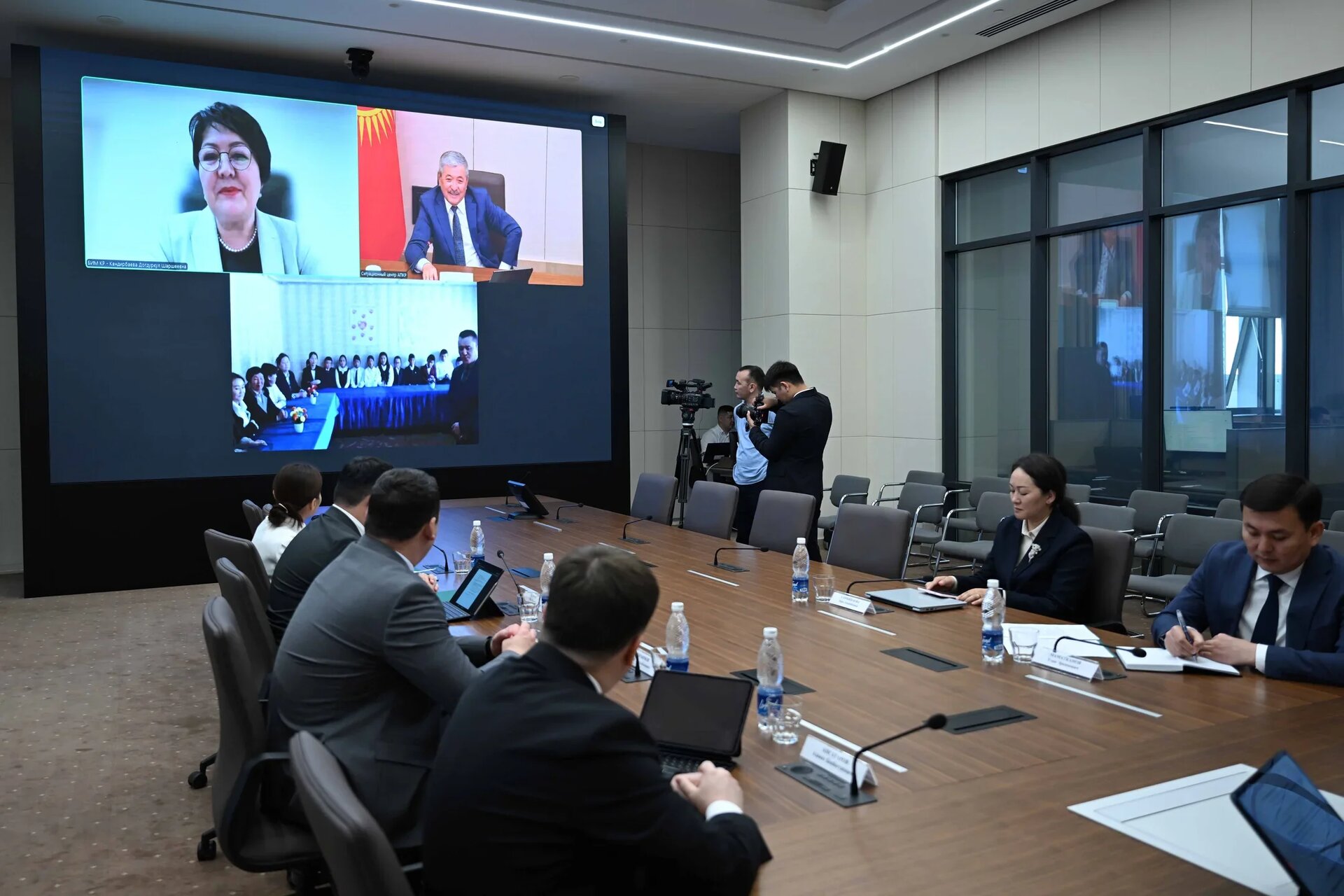
(Photo: Cabinet of Ministers/Kabar)
The role of ElCat and the local infrastructure of the project
The source indicates ElCat LLC As a local project partner, responsible for implementing the technical infrastructure in the country. The company has been operating since 1994 and is a Kyrgyz internet and telecommunications services provider with a data transmission backbone network, points of presence, and cross-border interconnections with Kazakhstan, Uzbekistan, and China. Its profile is consistent with the role required of a national partner in a satellite project: not just installing equipment, but integrating it into an existing network environment.
The presence of a local operator is significant for at least three reasons. The first is technical: satellite access must communicate with local routing, addressing, and support systems. The second is operational: schools, administrations, and end users require assistance, maintenance, and equipment management. The third is institutional: a public project requires responsibilities recognized throughout the country, especially when it involves schools and educational data.
In industrial terms, the case demonstrates how the orbital constellation economy is not just about satellites. The service involves terminal manufacturers, network operators, regulatory bodies, school administrations, integrators, and content providers. For local companies, the arrival of a global solution can generate service opportunities, but also the need to reposition themselves in a value chain where the space component is controlled by a few international players.
Already in 2024, the Ministry of Digital Development of Kyrgyzstan had announced a meeting with Starlink representatives dedicated to the implementation of satellite internet, the regulatory framework, and the establishment of a working group to evaluate a pilot project. Enilchek's connection therefore appears to be the operational outcome of institutional preparations initiated before the formal launch of the service.

(Photo: Jürgen Grösel/www.juergen-groesel.de)
A mountain school as a public testing ground
For the education sector, the issue directly concerns the training in remote areas. Internet availability can facilitate access to updated materials, communication with the ministry, electronic records, distance learning, teacher professional development, and participation in national programs. However, the real impact will depend on service continuity and the school's ability to use the connection routinely, rather than intermittently.
The reference to Mountains It's not just geographic. In high-altitude areas, connectivity is often a citizenship variable: it impacts access to education, healthcare, public services, civil defense, and economic opportunities. A school without internet isn't just a building without internet; it's a weak link in the relationship between the state and the local area.
For institutions, the challenge will be to prevent the satellite from becoming an isolated and fragmented response. If the project is extended to other schools still excluded, transparent criteria will be needed for priorities, costs, maintenance, service continuity, data protection, and measurement of educational outcomes. The small number of non-connected schools may make the objective technically manageable, but it does not eliminate the need for administrative oversight.
For the market, the Kyrgyz case confirms a trend already visible in many countries: satellite constellations are becoming complementary tools in universal connectivity policies. Their value lies not in replacing every other network, but in serving nodes that the terrestrial network struggles to reach. Schools, clinics, public offices, and emergency facilities are small users on a commercial level, but highly relevant on a social level.
From this perspective, Enilchek's school is more of an indicator than a point of arrival. Its connection demonstrates how access to the internet in remote areas is no longer just a matter of cables, pylons, and physical backbones. It's also a matter of low-orbit satellites, national authorizations, local partnerships, and the public capacity to transform a connection into a service. The difference, for students, will not be measured by the name of the constellation, but by the concrete possibility of using resources that until recently were out of reach, every day.
Here are three insights that might interest you:
Starlink among the Marubo: the network arrives in the Amazon rainforest.
In Sandwip the phone will connect directly to the satellites
Nuanua, the satellite connecting the future of Wallis and Futuna

(Photo: Starlink/SpaceX)


