SEARCH


NASA's new observatory launches on August 30th, studying exoplanets and dark energy and matter with a view 100 times wider than Hubble.

It will not have the largest mirror ever put into space and will not seek to replace the James Webb Space Telescope in observations of the deepest infrared Universe. The strength of the Nancy Grace Roman Space Telescope It will be another: to observe enormous portions of the sky while maintaining image quality comparable to that of Hubble and to collect, in a few years, an amount of data capable of transforming various sectors of astronomy.
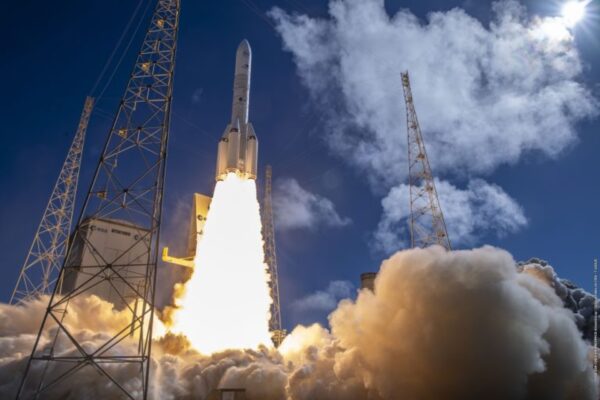
NASA's new large observatory is now on the eve of its launch. Construction is complete, the telescope has been transferred to Kennedy Space Center, in Florida, and in July 2026 technicians completed loading approximately 290 gallons of hydrazine. The launch is scheduled for August 30, 2026, aboard a Falcon Heavy, bound for the second Sun-Earth Lagrangian point, L2.
It is the same gravitational environment in which James Webb operates, about 1,5 million kilometers from Earth, but Roman will face the sky with a profoundly different strategy.
Its primary mirror measures 2,4 meters in diameter, substantially as large as Hubble's and much smaller than Webb's 6,5 meters. Yet its main camera will be able to observe a field of sky at least one hundred times larger than Hubble's maintaining high-resolution images. A single Roman exposure could therefore contain an amount of the Universe that would require a mosaic of many images obtained with the veteran space telescope.
The revolution therefore does not consist only in seeing more distant objects, but in being able to see many more objects at the same time.

From the “old” Hubble to panoramic photography of the Universe
To understand Roman, it helps to think about the difference between a powerful telephoto lens and a camera capable of maintaining nearly the same sharpness over an immensely wider frame.
Hubble has built a fundamental part of modern astronomy by observing relatively small regions of the sky in extraordinary detail. Roman will combine high resolution with unprecedented panning capabilities for a space observatory of this class.
The heart of this ability is the Wide Field Instrument, or WFI, a giant camera intended primarily for near-infrared observations and slitless spectroscopy. NASA describes it as a camera of approximately 300 megapixel; the mission documentation also uses the value of 288 megapixels when referring to the scientific array of the detectors.
Its field of vision will cover approximately 0,28 square degrees of sky per exposure. It may not seem like much, but for an instrument capable of obtaining deep, detailed images from space, it represents a huge surface area.
The Nancy Grace Roman will thus be able to carry out large cosmological surveys instead of observing mainly single targets.
During its primary mission, which is expected to last at least five years with the aim of extending it up to ten, the telescope could measure the light coming from a billion galaxiesNASA also estimates data volumes of the order of 20 petabytes during the first five years of operations.
It is a quantitative difference destined to produce qualitative consequences.
As observed populations grow from thousands or millions of objects to hundreds of millions or billions, extremely rare phenomena can emerge statistically, and difficult-to-recognize cosmic structures become measurable with much greater precision.
Roman will be, in this sense, not only a telescope but a machine for building statistical maps of the Universe.


Dark energy and dark matter under an innovative lens
One of the big questions Roman will try to answer is why the expansion of the Universe is accelerating.
At the end of the twentieth century, observations of distant supernovae showed that the cosmos is not simply expanding: this expansion is accelerating. To describe the unknown cause of this phenomenon, the term "supernova" was introduced. dark energy, but understanding its nature remains one of the fundamental problems of cosmology.
Roman will study the evolution of cosmic expansion using several complementary methods.
These include observations of supernovae, the three-dimensional distribution of galaxies and above all the weak gravitational lensing.
According to general relativity, matter curves spacetime and bends the path of light. The distribution of enormous amounts of mass along the line of sight therefore produces subtle statistical deformations in the images of distant galaxies.
By measuring these effects on gigantic populations of objects, astronomers can reconstruct the distribution of matter across billions of light-years.
This is where the dark matter, which neither emits nor reflects light, but manifests its presence through gravitational effects.
Roman should therefore allow us to construct some of the most detailed maps ever obtained of the cosmic structure, relating the distribution of matter to the evolution of the expansion of the Universe.
It won't be a photograph of dark matter in the traditional sense. It will be something more subtle: an indirect reconstruction based on the gravitational effects exerted on light from much more distant objects.
The enormous surface of sky observable by Roman is precisely what makes this kind of precision cosmology possible.


Hundreds of thousands of new worlds thanks to microlensing
Cosmology is only half the story.
The Nancy Grace Roman will also be an extraordinary machine for the discovery of exoplanets.
One of its large surveys will observe dense star fields towards the center of the Milky Way in search of events. gravitational microlensing.
The principle stems once again from general relativity. When a star passes almost perfectly in front of another, more distant star, the gravity of the foreground object can act like a lens, temporarily amplifying the light from the background source.
If a planet orbits the lens star, its gravity can produce a small additional perturbation in the luminosity curve.
It is a transitory phenomenon: the alignment occurs and then disappears.
But by simultaneously monitoring millions of stars with great precision, Roman will be able to turn these rare events into a powerful statistical tool.
NASA expects its observations to contribute to the discovery of hundreds of thousands of exoplanets, exploring a region of planetary parameter space different from that favored by transit-based missions.
Microlensing is particularly interesting because it can detect planets relatively far from their star and even contribute to the search for so-called wandering planets, worlds that could pass through the Galaxy without orbiting a star.
Roman will therefore contribute not only to increasing the number of known exoplanets, but to better understanding how common different planetary architectures are in the Milky Way.


The coronagraph prepares the telescopes that will search for other Earths
One of the most technologically important experiments for the future of exoplanet astronomy will also travel on board the Nancy Grace Roman: the Coronagraph Instrument.
Unlike the Wide Field Instrument, the coronagraph is not the mission's primary scientific instrument. It is primarily a technology demonstrator designed to test ultra-high-contrast imaging techniques in space.
The problem to be solved is as simple to describe as it is difficult to tackle.
A planet is vastly fainter than the star it orbits. Observing it directly means suppressing the star's glare without simultaneously eliminating the very faint light reflected by the planet.
Roman's coronagraph uses a combination of masks, filters, prisms, detectors and deformable mirrors, capable of modifying their surface with extreme precision to correct imperfections in the wavefront.
NASA aims to obtain images of planets and circumstellar disks with contrast capabilities up to about a thousand times higher than those previously achieved by other observatories under certain operating conditions.
Roman is not designed to photograph a true Earth analogue around a Sun-like star.
But what we learn from his coronagraph could be crucial to our success in the future.
The technologies experimented by Nancy Grace Roman are in fact one of the steps towards the future. Habitable Worlds Observatory, the large observatory that NASA is planning to obtain direct images of potentially habitable rocky worlds and analyze their atmospheres.
From this perspective, Roman is also a bridge between current astronomy and one that could systematically search for biosignatures on extrasolar planets.
Roman was conceptualized, built, and tested at @NASAGoddard. After thousands of hours of work by hundreds of people with one goal in mind, the observatory was completed and shipped down to @NASAKennedy, where it is being prepped for its final journey to space. pic.twitter.com/IE4VeZHMXK
— Nancy Grace Roman Space Telescope (@NASARoman) July 28, 2026
A Hubble Mirror for a Whole New Mission
The story of the Nancy Grace Roman's primary mirror is also peculiar.
At 2,4 meters, it is similar in size to Hubble. However, this choice is not an attempt to replicate the old observatory.
The project, originally born with the name Wide Field Infrared Survey Telescope, or WFIRST, benefited from the availability of optical hardware from the U.S. National Reconnaissance Office. The mission was later redefined and in 2020 dedicated to Nancy Grace Roman, NASA's first Chief of Astronomy, a key figure in the birth of the Hubble Space Telescope.
The choice of the name therefore creates a very strong symbolic continuity.
The Tennessee astronomer, who passed away in 2018 at the age of 93, helped pioneer an observatory that would transform our ability to study individual cosmic objects in great detail. The telescope that now bears her name will extend that same observational quality to surveys of vastly larger scales.
NASA summarizes the comparison by stating that Roman
“it will have a field of view at least a hundred times wider than Hubble.”
It is therefore incorrect to simply ask which telescope is “more powerful”.
The James Webb has a much larger mirror and is optimized for a broad infrared region. Hubble retains particularly valuable capabilities in the ultraviolet and visible ranges. Nancy Grace Roman it is instead built around the combination between resolution, field of view and survey speed.
They are different tools for different problems.

From Goddard Space Flight Center to the L2 point in space
Construction of the Nancy Grace Roman Space Telescope was completed in 2025 at the Goddard Space Flight Center of NASA in Greenbelt, Maryland.
After integration and a long series of environmental, thermal, acoustic, and mechanical tests, the observatory left Goddard in June 2026 for Florida. The move concluded a process lasting over a decade during which components manufactured at different U.S. facilities were progressively assembled into the complete observatory.
At Kennedy Space Center, Roman entered the final phase of launch preparation.
On July 25, the loading of hydrazine for the propulsion systems was completed. If the current schedule is respected, on August 30 a Falcon Heavy will take him into space.
Roman will then head towards L2, where Earth and the Sun appear in approximately the same direction and an observatory can maintain favorable thermal and geometric conditions for prolonged observations.
The nominal mission will last five years, with an operational goal of ten. NASA has also designed the observatory so that it can, in principle, be robotically refueled in space, a feature that already looks to a future in which maintenance and servicing could become standard elements of the architecture of large scientific missions.


The telescope that will transform the sky into a huge data archive
A final difference from previous generations of observatories concerns the scale of the data.
NASA indicates that Roman has a transmission capacity of the order of 250-500 megabits per second and a production that can reach approximately 11 terabits of data per day.
These are numbers that also change the way we do astronomy.
Roman will produce large datasets usable by scientific communities much larger than the groups that designed the original surveys. Within the same images used to study dark energy and exoplanets, it will be possible to identify asteroids, supernovae, variable stars, distant galaxies, black holes, and previously unforeseen phenomena.
This is one of the most promising aspects of astronomical research: we don't know in advance everything they contain.
Hubble taught us how scientifically fruitful it can be to peer deeply into a small region of the sky. James Webb pushed that gaze toward the farthest infrared Universe.
Il Nancy Grace Roman will add another dimension: the ladder.
It won't necessarily observe farther than the James Webb, nor will it always produce more detailed images than the Hubble Space Telescope. But it will be able to repeat high-quality observations over immensely larger areas of sky, building a cosmic census that no previous space telescope was designed to achieve.
On August 30, 2026, if the schedule is respected, it will not simply be another large telescope that will be launched.
An observatory will be launched, designed to transform the sky from a succession of individual targets into a huge dynamic map of the Universe.
Nancy Grace Roman Space Telescope: Anatomy of NASA's New Observatory
Nancy Grace Roman: Here's How NASA's Telescope Will Map the Cosmos
Here are three insights that might interest you:
Euclid, the ESA mission to hunt for the dark forces of the universe
A wonder of a telescope in a universe of wonders
LIFE, the Swiss mission searching for life beyond Earth