SEARCH



After GO!2025, digital infrastructure becomes a permanent public space between generative art, engineering and cross-border regeneration.
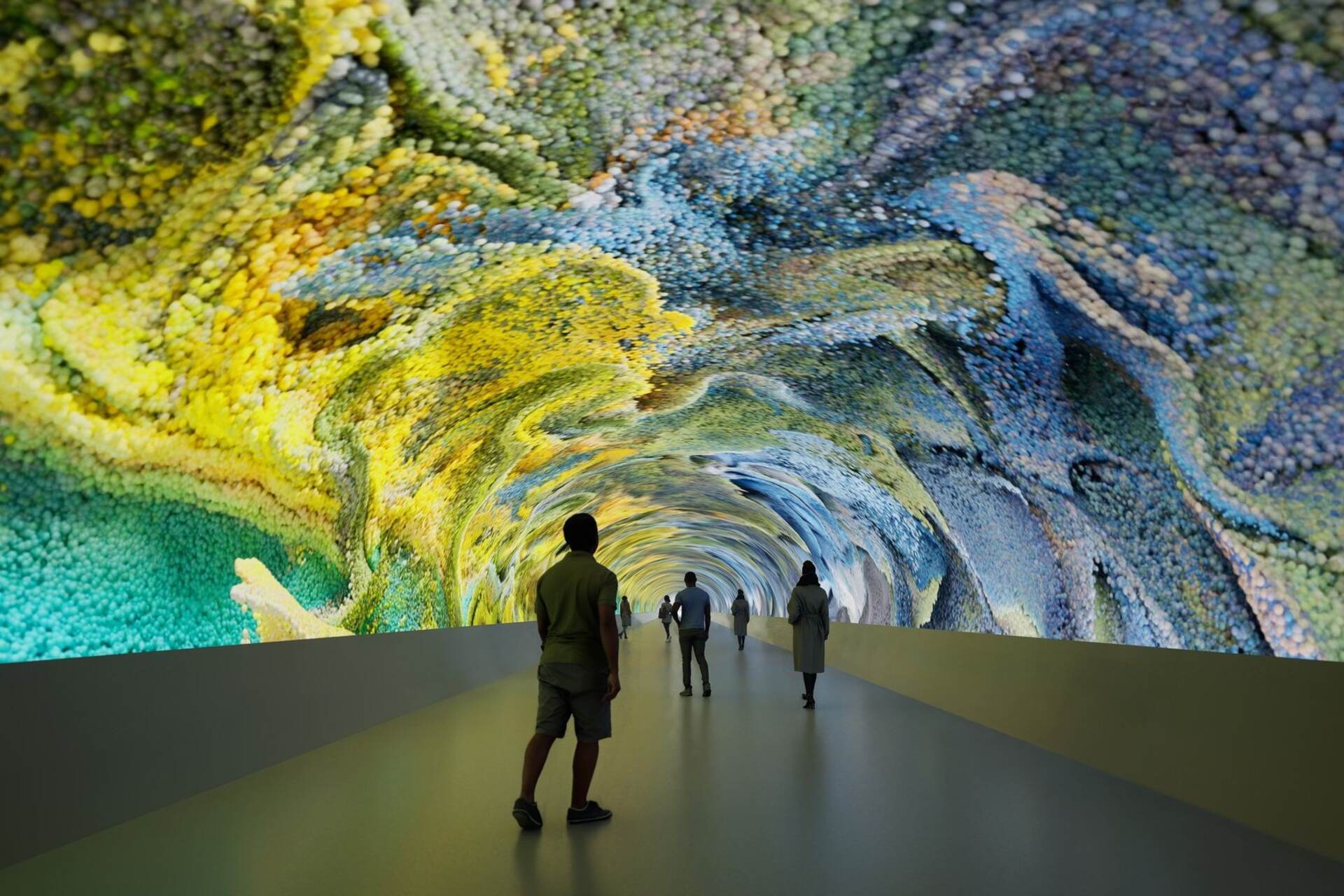
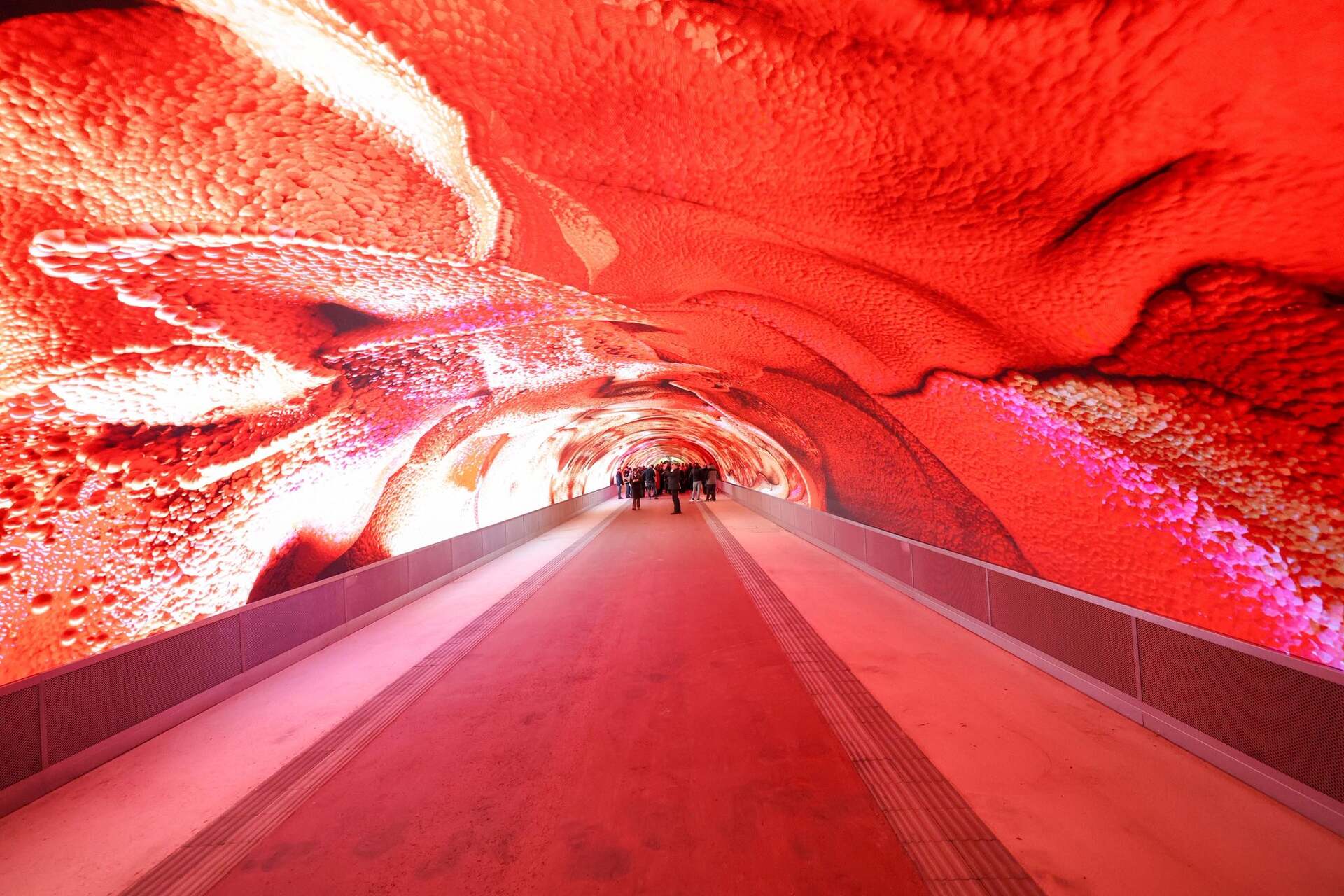
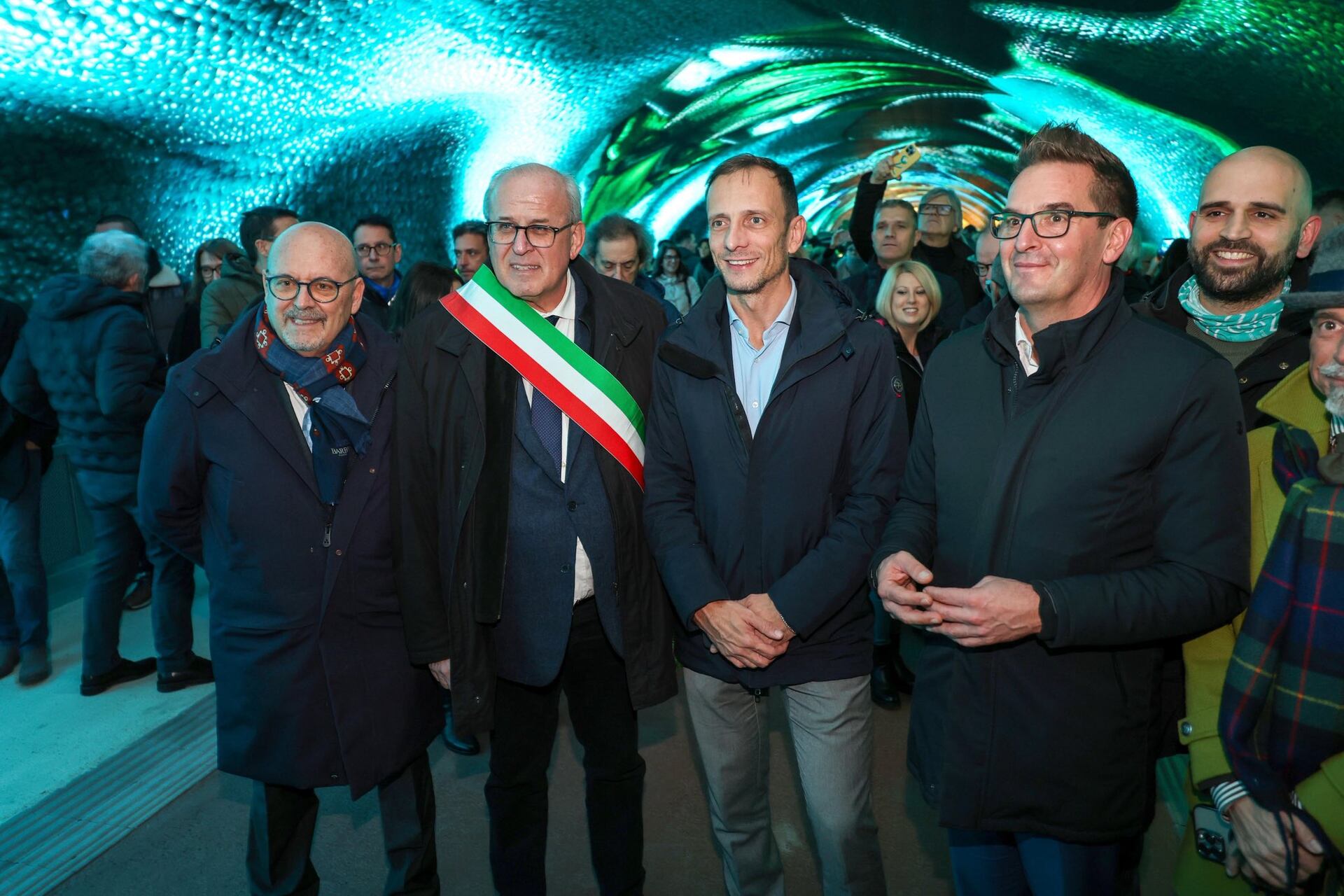
More than a year after the launch of the program “Gorizia–Nova Gorica European Capital of Culture 2025”, the Bombi Gallery It has now become one of the most visible and ongoing infrastructural legacies of the entire project. What until a few years ago was a simple covered pedestrian walkway is now a permanent immersive space, featuring a 100-meter LED wall covering 925 square meters, integrating digital art, urban flow management, and new ways of enjoying culture in public spaces.
The intervention, known as DAG-Digital Art Gallery, was made by Electron Italia for electrical systems and security systems, in partnership with Videomobile, LED division of the M-Cube Group, a group with operational headquarters in Trieste and an international presence in digital solutions for retail, corporate, and urban spaces. By 2026, once fully operational, the gallery will be one of the largest permanent immersive LED environments in Europe, conceived not as a simple support for video content, but as a cultural infrastructure integrated into the existing architecture.
From a performance point of view, the system works with 2,5mm pixel pitch has always been overall resolution of 40.000 by 3.700 pixelsThese features allow for high visual quality even at close range, a prerequisite for a space traversed daily. The images accompany visitors' movements throughout the gallery, transforming their transit into a continuous perceptual experience, without creating concentration points or forced lingering zones.
Self-supporting structure and adaptation to a historic building
One of the most delicate elements of the project was the adaptation of LED technology to a historic tunnel, with stringent architectural constraints and the need to avoid any interference with the load-bearing surfaces. For this reason, the entire system rests on self-supporting load-bearing structures, completely free from walls and vault, for a total weight of 37.000 kilograms.
The system is composed of 3.700 LED cabinets, secured with 6.000 structural screws and 44.400 connecting screws, with 14.800 electronic boards featuring a protective nano-coating treatment and GOB-Glue on Board technology, chosen to increase mechanical resistance and protection from humidity in a high-traffic urban environment.
The infrastructure's complexity extends beyond the visible surface. The management system integrates fiber converters, CAT6 and fiber optic cabling, as well as a complex network of power cables and high-section conductors from the electrical substation to the main switchboard. The system is completed by electrical ducts and forced ventilation systems, necessary to maintain thermal stability throughout the entire vault.
Content playback is handled by professional workstations that handle 4K video signals, allowing for flexible programming and the ability to update or reconfigure the viewing experience without physically modifying the structure.


Generative art as an everyday urban language
The first cycle of contents, inaugurated at the end of 2025, was signed by the digital artist Refik Anadol, known for its use of complex datasets and artificial intelligence models to build immersive visual environments. Throughout 2026, the works were complemented by new thematic programs related to cultural events, temporary exhibitions, and cross-border initiatives, transforming the gallery into a constantly evolving visual program.
The choice to focus on generative art and dynamic content responds to a specific need: to prevent the installation from becoming a mere decorative backdrop, and instead to transform it into a narrative device capable of adapting to the city's cultural calendar. In this sense, the technological platform becomes an infrastructure for cultural production, not just for exhibition.
Secondo Manlio Romanelli, President of M-Cube Group,
"After thousands of installations in commercial and museum settings, the Bombi Gallery represents a step toward a more structural use of LEDs in public spaces. Here, the technology isn't a support, but rather an integral part of the architecture and everyday urban experience."
It is a perspective that shifts the focus from the single event to the long-term nature of the investment.

Industrial skills and local technological supply chain
The installation required 30 consecutive days of assembly, with 12 specialized technicians engaged in installation, cabling, color calibration, and synchronization testing across the entire length of the vault. This work combined engineering expertise, artisanal precision, and the management of complex digital systems in an operational urban environment.
For Christian Bragato, Chief Executive Officer of Videomobile,
“The difficulty was not only in the size, but in the geometric continuity of the curved structure and in the need to ensure visual uniformity along one hundred meters without perceptible points of discontinuity.”
The plant engineering, overseen by Electron Italia, also required custom solutions to integrate power, security, and video surveillance without interfering with pedestrian flow. In this sense, the project represents an example of collaboration between technology companies and local government, oriented toward the permanent use of the space.
Digital public space and new models of use
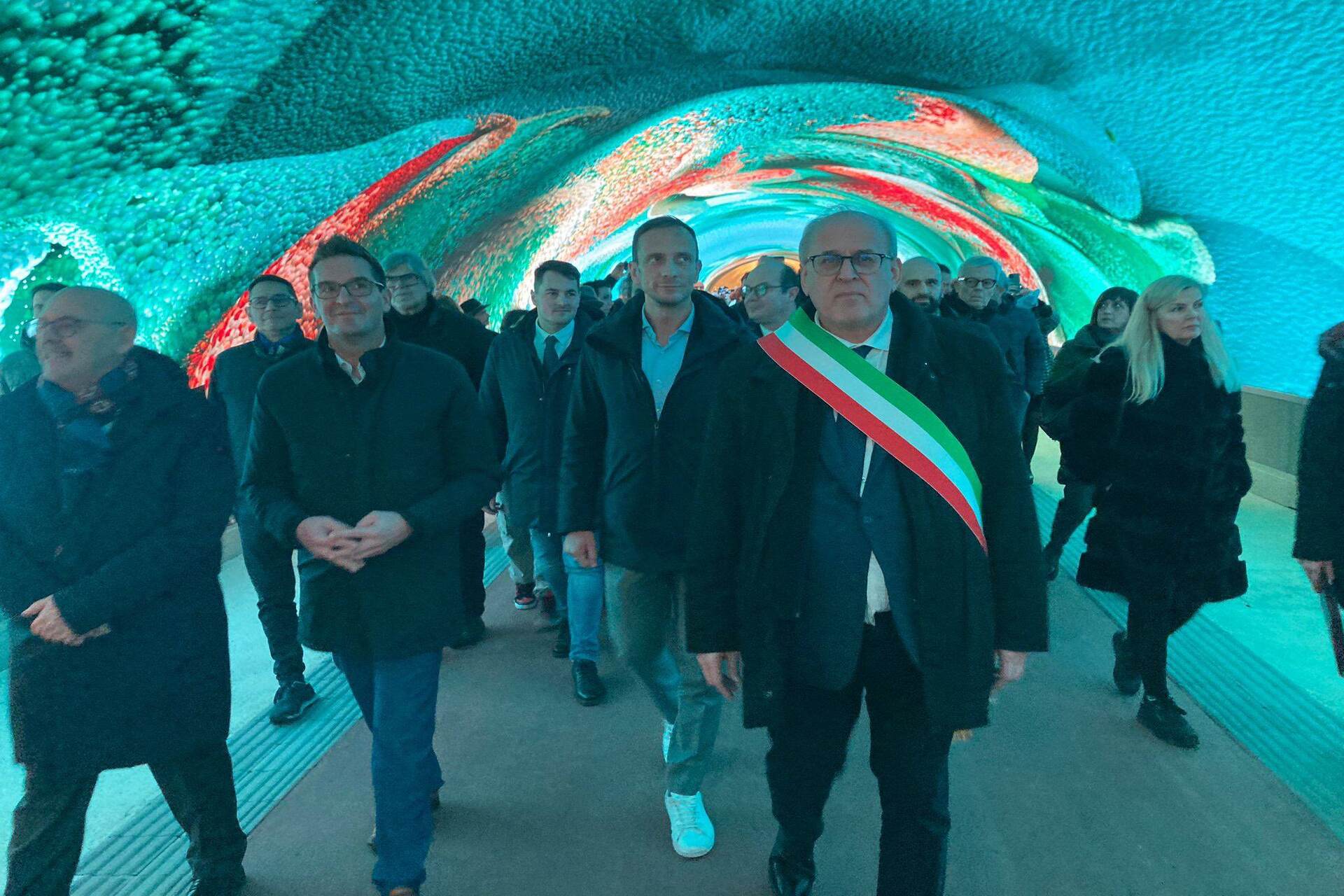
In 2026, with the novelty effect now absorbed, the Bombi Gallery It is used as an active urban corridor, traversed daily by residents, students, and visitors. This seemingly trivial fact is crucial to assessing the impact of innovation: the technology is not located in a separate space, but integrated into a functional pathway, where use is often unintentional, rapid, and repetitive.
From a design perspective, this required choices geared toward visual continuity and the avoidance of overly intrusive stimuli. The presence of dedicated fiber connectivity also allows for the future integration of content based on real-time data and collaborations with local scientific and cultural institutions.
As it observes Leonardo Comelli, Commercial Director of M-Cube,
"The value of an infrastructure like this is measured by its ability to be reused and reinterpreted over time, not just by the impact of its inauguration. The platform is ready to host new formats and new collaborations."
An infrastructural legacy that looks to the medium term
Months after the official closure of the European Capital of Culture programme, the Bombi Gallery It continues to function as an active urban device, demonstrating how immersive technologies can play a structural role in the regeneration of public spaces. The project goes beyond simply introducing a large screen; it builds a permanent digital infrastructure, designed to adapt to content, languages, and functions that will evolve over time.
In the European landscape, where many digital regeneration initiatives remain tied to temporary installations or pilot projects, the experience of the city of Venezia Giulia suggests a different possible trajectory: investing in hardware as a cultural platform, upon which to graft artistic production, institutional communication, and visual experimentation over time. The challenge of the coming years will not be so much technological as curatorial and managerial, ensuring that technology remains a means, not an end, of urban storytelling.
The spectacular effects of the Digital Art Gallery in Gorizia
Here are three insights that might interest you:
Slovenia, a small Balkan country with big green ambitions
Nonino, a… welcoming grappa with innovative communication
Maribor opens the ARNES data center and relaunches Slovenian open science