SEARCH


Presented at the Safety Expo, the Lombardy platform will connect each course to the certificates issued, so as to verify their origin and authenticity.

How can you know if a safety certificate reflects actual training? How can you verify its origin without initiating lengthy and complex checks? And how can you reconstruct a worker's history when that document needs to be used elsewhere, perhaps even outside of Italy? Soon, in Lombardy, all the answers will be found in a single platform responsible for following each document, from the creation of the course to its use.
The system, introduced by the regional law of 10 February 2026, n. 4, will allow the recording of courses organized by training institutions and those managed directly by employers for employees, supervisors, and managers, thus creating a single database of activities carried out in the region. The new model will be completed by a regional list of training providers, while interoperability with the National Information System for Social and Labor Inclusion will allow data exchange with participating companies and organizations.
"The Lombardy Region's commitment to this matter is important, because we're talking about a topic that concerns workers' health and directly impacts companies' operations."
lets know Ivan Rota, regional councilor, member of the Special Commission – Protection of Health and Safety in the Workplace of the Lombardy Region.
The instrument was presented during the Safety Expo 2026, the event dedicated to health and safety in the workplace, which brought together institutions, companies, associations, and industry professionals at the Bergamo Fair on September 16th and 17th. Featuring technical innovations and regulatory updates, the event hosted 300 exhibitors, 250 speakers, and 130 events, attracting a total of over 11 attendees.
Inside the regional law that redesigns safety training
The platform is only the most visible face of regional law, which affects the entire training system to improve quality, even before certifying the validity of certificates. Alongside the digital tool, the measure introduces the aforementioned regional list, dividing it into three sections (as well as institutional entities, accredited bodies, and other trainers) and establishes the necessary requirements for offering courses in Lombardy.
Each course must be communicated before it begins, including the list of participants and the schedule. The training provider must notify the completion of the course within thirty days of its conclusion. The ATS (Health Protection Agencies) will then be able to access the data to conduct monitoring and control activities. To ensure compliance with these obligations, the law provides penalties for those who offer courses without being registered in the regional register, fail to provide the required communications, or issue certificates not generated by the platform.
Behind this regulatory architecture there is a shared effort between the various actors in health and safety at work, as explained Nicoletta Cornaggia, manager in the Health Prevention from Environmental, Climatic and Occupational Risks structure of the General Welfare Directorate:
The law is the result of an agreement between institutions, employers' organizations, and trade unions, with the involvement of INAIL. It is, therefore, the product of the entire institutional system.

How the database that will track each certificate, from its origin to its use, works
The regional resolution of August 3, 2026 defined the characteristics of the platform and gave it a name: Ge.Fo.S.Safety Training Management. The system will collect information currently scattered across various institutions, companies, documents, and registers into a single database, linking each course to the organization that organized it and the certificates issued. This way, those who need to conduct an audit will be able to reconstruct the entire training process without having to contact multiple offices or rely solely on the documentation submitted.
After all, reducing time and bureaucratic procedures is anything but secondary, especially when the certificates are to be used outside of Italy. An episode told by Nicoletta Cornaggia demonstrates this:
We've had cases involving Italian workers employed abroad who were asked to verify certificates relating to courses held in Lombardy. Tracing the provider of the training turned into a full-blown investigation. With the new system, we want to trace each certificate from its origin to its use, eliminating any doubts about its authenticity.
Before the start of operations, Ge.Fo.S. will go through an experimental phase This will allow operators to familiarize themselves with the system and allow the Region to identify any potential critical issues. Meanwhile, the Lombardy model has already attracted the attention of other organizations and could soon become a benchmark for similar tools nationwide. Cornaggia further explains:
At the national level, the 2025 State-Regions Agreement postponed the definition of the control and monitoring system to a later date. In Lombardy, we have begun to build it thanks to the collaboration of all stakeholders.
The Safety Expo is the meeting point between the culture of prevention and the business world.
For Rota, making training more controllable also means recognize its value within companies and adapt it to an increasingly complex world of work:
Productivity is crucial, and companies' accounts need to balance, but too often what is actually an investment is considered a cost: training, tools, and everything that contributes to worker protection. Between contractors and subcontractors, people who speak many different languages can work on the same construction site, so it's necessary to develop training programs that also take linguistic and cultural differences into account. We need to be able to reach all workers. Regulations are needed, but also awareness and responsibility on the part of companies and workers. It's the combination of these elements that creates true prevention.
If the goal is to be able to speak to all workers and transform training into a concrete prevention tool, there could hardly have been a more suitable venue than the Safety Expo to present Ge.Fo.S. In the Bergamo pavilions, in fact, the discussion on safety went beyond the mere regulatory dimension to translate into technologies and solutions already applicable in the workplace, with a program that combined conferences and professional development opportunities with the offerings of over 300 exhibiting companies, creating a direct meeting space between those involved in training and those developing prevention and protection systems.
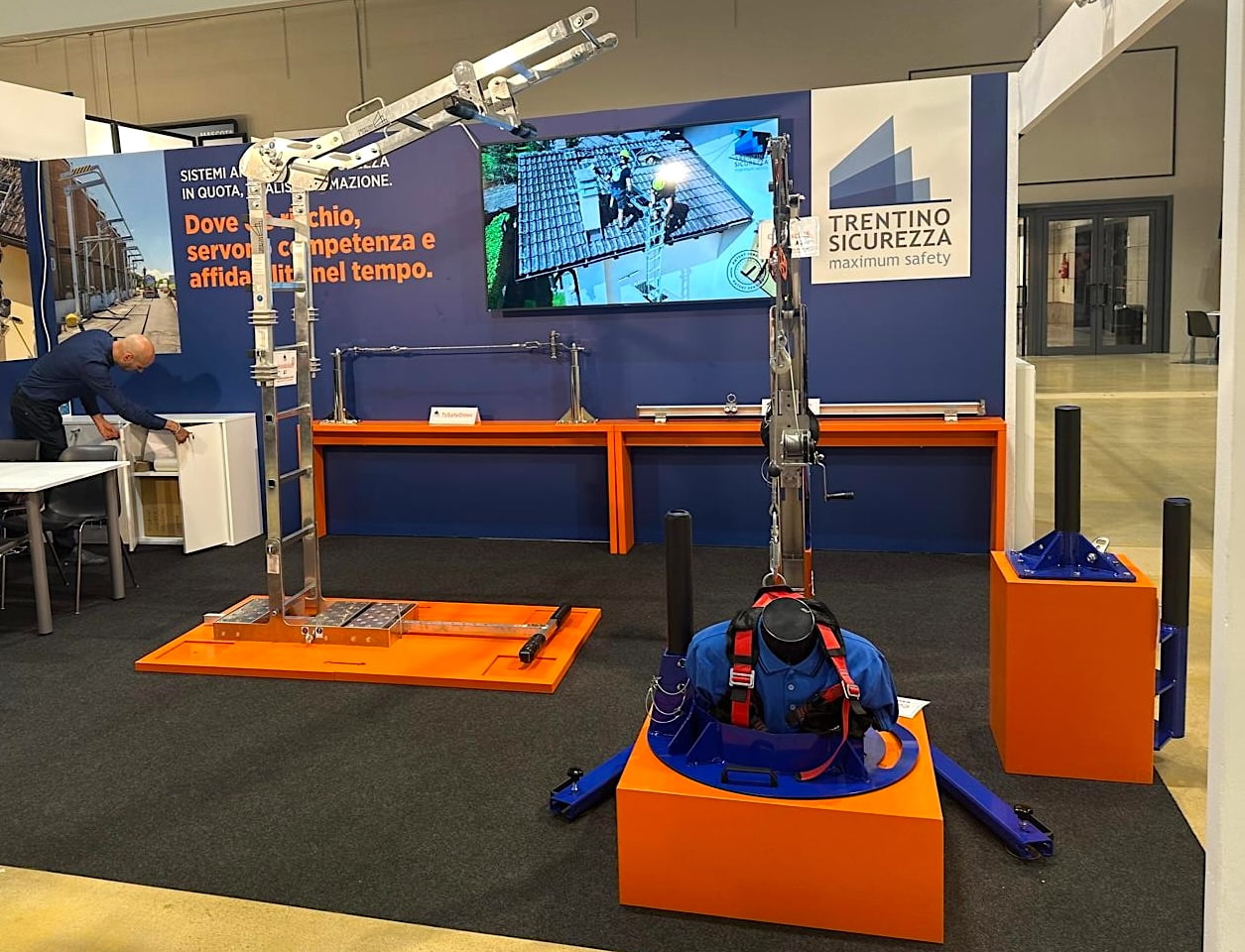
Among the realities present also Trentino Security, which brought to the fair devices designed for working at heights and in confined spaces, engaging directly with consultants, RSPPs, designers, and installers. This participation perfectly captures the spirit of the event: bringing together different skills and bring the institutional debate closer to the real needs of workers.

A look at the 2026 edition of Italy's leading workplace safety trade fair.
Here are three insights that might interest you:
Italy launches portal making labor laws accessible
Is the price of efficiency increasingly monitored work?
When healing isn't enough: How Singapore reinstates injured people